Animal welfare certifications on beef
A welfare seal becomes useful only when the exact beef product, the certifier's current directory, the species standard, and a realistic buying path all connect.
- Published
- Category
- Beef
- Sources
- 22 cited
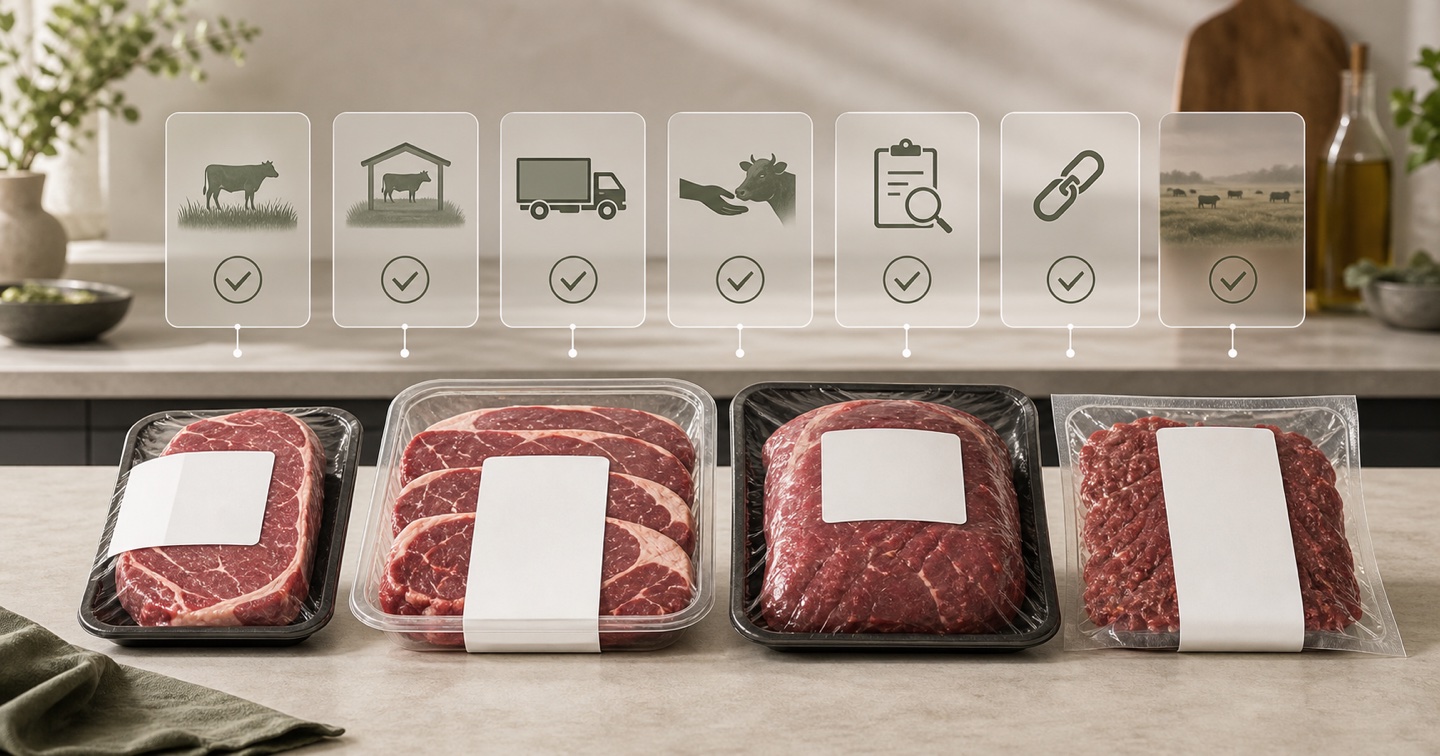
The short version
An animal-welfare seal on beef is useful only when four pieces line up: the exact product names the certification or tier, the verifier currently lists the relevant beef program, the public cattle standard says what gets audited, and shoppers have a realistic way to buy that product. A brand logo elsewhere on the website is not enough. Neither is a certification attached to a sibling steak, burger, or subscription box.
On that strict public-evidence test, Bachman Family Farms 80/20 Ground Beef leads because it connects a current direct-farm product to Certified Animal Welfare Approved and Certified Grassfed by A Greener World. Panorama Meats 93/7 Organic Grass-Fed Step 4 Ground Beef is the strongest exact retail-tier example. First Light Wagyu Ground Beef and Niman Ranch's Regenerative Organic Certified 80/20 Ground Beef provide strong Certified Humane trails. Pineland Farms Chef Blend Ground Beef Patties show what a clearly identified G.A.P. Step 1 baseline looks like.
This is a ranking of public certification signals, not a declaration about every animal or ranch visit. An audit samples compliance at a point in time. A high score is not a health claim, food-safety claim, taste test, environmental ranking, or guarantee of local stock.
What the major beef certifications cover
Certified Animal Welfare Approved by A Greener World has the strongest public standard in this comparison. AGW says the program covers animals from birth through slaughter, requires pasture or range throughout their lives, and uses annual independent audits. Its current beef cattle standard includes body-condition requirements, treatment obligations, handling and transport rules, slaughter controls, restrictions on physical alterations, and input-output records for traceability. Dehorning is prohibited, late disbudding and castration are restricted, and each participating member of a production network must be audited. One limitation deserves precision: the standard recommends pain relief for castration rather than requiring it in every permitted case.
Global Animal Partnership is tiered, so the number on the exact package matters. G.A.P. says farms receive on-site visits from independent third-party certifiers every 15 months through its current producer process. Its current-linked beef standard applies written health, handling, transport, identification, and traceability controls across every step. It also publishes measurable limits for issues including lameness and assisted calving. Step 4 is pasture-centered. Step 1 is the program's no-crowding baseline and does not inherit Step 4's pasture requirements. That difference is why a company listed for both Steps 1 and 4 cannot put every product at Step 4.
Certified Humane publishes a comprehensive beef cattle standard covering nutrition, outdoor range or pasture, housing, animal-health planning, handling, transport, physical alterations, and slaughter. Its processing rules require traceability so products using the logo originate with Certified Humane farms. The current Certified Humane directory is unusually valuable because it names certified companies and product categories. It also gives shoppers the central warning for this article: listed companies may sell uncertified products, and only the products listed and carrying the logo qualify.
Organic, grass-fed, grass-finished, regenerative, and “pasture raised” can add context, but they are not interchangeable with these animal-welfare certifications. Bachman's Certified Grassfed by AGW is meaningful partly because that add-on cannot stand alone; the cattle must also meet AGW's welfare standard. Niman's Regenerative Organic Certified product adds soil-health and social-fairness requirements, but this ranking separately credits only the welfare programs demonstrably attached to its exact ground beef. USDA FSIS's animal-raising claim guideline reinforces the underlying rule: animal-raising claims need substantiation, traceability, and segregation rather than implication.
How Fridgeful scored the products
Exact-product certification linkage carries 25 of 100 points because it prevents the most common shopper error: transferring a legitimate seal to the wrong package. Public species-standard strength and independent audit or chain controls receive 20 points each. Animal-outcome and handling specificity receives 15; product-to-farm traceability receives 10; current availability and claim discipline receive five each.
No product earned ten traceability points because none offered a public consumer lookup from the reviewed package to an individual ranch. Bachman came closest as a direct single-farm seller. Panorama's retailer page says the beef is traceable to a farm or ranch, but it does not expose that trace to the online shopper. The multi-ranch First Light and Niman programs publish useful origin context without a pack-level lookup. Pineland's public evidence identifies the certification tier but not the contributing farm.
Brand-by-brand read
Bachman Family Farms leads at 96. Its current store sells an exact one-pound 80/20 ground-beef package, and its certification page says its beef is both Animal Welfare Approved and Certified Grassfed by AGW, with a yearly in-person audit. AGW's current Bachman directory listing independently identifies certified beef and continental U.S. shipping. The two-point linkage deduction reflects that the individual 80/20 product card does not itself repeat the seal. Broad nutrition claims on the store page are excluded from the ranking.
Panorama scores 94. The exact Whole Foods page names the 93/7, 16-ounce ground beef as organic, grass-fed and Step 4; it also says the item is G.A.P. certified and traceable to a farm or ranch. G.A.P.'s current products-and-brands directory independently lists Panorama beef at Step 4. That closes the exact-product loop more cleanly than most retailer listings. The remaining limitation is shopper-facing traceability: the statement exists, but there is no public lot-to-ranch lookup.
First Light scores 89. Its U.S. store currently offers four individually packed pounds of 80/20 Wagyu ground beef and explicitly states Certified Humane, 100% grass-fed and finished, and pasture access. Certified Humane's directory lists First Light grass-fed Wagyu beef. Direct ordering earns full availability credit, while the absence of a package-level farm lookup and the directory's product-category wording keep it below the two leaders.
Niman Ranch scores 87. Its exact 80/20 Regenerative Organic Certified ground-beef section says the product is Certified Humane, certified organic, pasture raised, grass fed and finished, and born, raised and harvested in the United States. The Certified Humane directory specifically lists Niman ground beef and grass-fed ground beef. This is an unusually strong current certification stack, but availability is still a catalog and newly launched retail program rather than an exact direct-buy path. Niman's G.A.P. Step 4 ranch listing is not transferred to this SKU because the reviewed package does not claim G.A.P.
Pineland scores 82. Its exact 12-ounce Chef Blend patty page says G.A.P. Step 1, while G.A.P.'s directory lists Pineland beef programs at Steps 1 and 4. Only Step 1 counts here. The exact page does not become pasture-centered merely because a sibling Pineland supply stream reaches Step 4. That narrower standard and limited farm traceability explain the gap from the leaders.
Fridgeful Signal Ranking
Eligibility requires an exact U.S.-shopper-facing beef product, a product-specific certification statement or a defensible current verifier bridge, and current availability evidence. Criteria scores below follow this order: exact-product linkage out of 25; public standard out of 20; audit and chain controls out of 20; animal-outcome specificity out of 15; traceability out of 10; availability out of five; and claim discipline out of five.
| Rank | Exact product | Score | Criteria scores | Best shopper read |
|---|---|---|---|---|
| 1 | Bachman Family Farms 80/20 Ground Beef | 96 | 23/20/20/15/9/5/4 | Strongest pasture-based single-farm trail. |
| 2 | Panorama Meats 93/7 Organic Grass-Fed Step 4 Ground Beef | 94 | 25/19/19/15/7/4/5 | Strongest exact retail Step 4 linkage. |
| 3 | First Light Farms Wagyu Ground Beef | 89 | 24/18/18/13/7/5/4 | Best direct-order Certified Humane example. |
| 4 | Niman Ranch ROC Pasture Raised Ground Beef 80/20 | 87 | 25/18/18/13/6/3/4 | Strongest current U.S. certification stack. |
| 5 | Pineland Farms Chef Blend Ground Beef Patty | 82 | 25/15/18/11/4/4/5 | Clear exact-product Step 1 baseline. |
Availability and the product Fridgeful did not rank
Current product pages prove a buying path, not inventory everywhere. Bachman's page showed its 80/20 ground beef at $13.74 per pound, and AGW describes continental U.S. shipping. First Light showed $39 for four pounds and an in-stock direct-order path. Whole Foods exposed add-to-cart pages for Panorama and Pineland but requires a selected store for accurate price and stock. Niman publishes an exact current product and a 2026 U.S. program launch, but no durable direct checkout was found.
ButcherBox's current 85/15 ground-beef page does not pass the gate. Its FAQ says land-animal suppliers may be audited or certified by either Certified Humane or G.A.P. That does not tell a shopper which program—or which G.A.P. tier—covers the exact 85/15 pack. The product therefore remains an unresolved candidate, not a ranked Certified Humane or G.A.P. item.
The practical rule is simple: read the exact package, record the full certification name and tier, and confirm that product against the verifier's current directory. Keep grass-fed, organic, regenerative, taste, nutrition and safety questions separate. A real seal can support a purchasing decision; a seal borrowed from another SKU cannot.
Sources
- FSIS Guideline on Substantiating Animal-Raising or Environment-Related Labeling Claims. USDA Food Safety and Inspection Service. Accessed 2026-07-26.
- Certified Animal Welfare Approved by AGW. A Greener World. Accessed 2026-07-26.
- Certified Animal Welfare Approved by AGW Beef Cattle Standards. A Greener World. Accessed 2026-07-26.
- Bachman Family Farms certified-beef directory listing. A Greener World. Accessed 2026-07-26.
- A Greener World Approved Products shopping guide. A Greener World. Accessed 2026-07-26.
- Animal Welfare Standards. Global Animal Partnership. Accessed 2026-07-26.
- Beef Standards and Application. Global Animal Partnership. Accessed 2026-07-26.
- G.A.P. Animal Welfare Standards for Beef Cattle. Global Animal Partnership. Accessed 2026-07-26.
- G.A.P. Producer Certification Process. Global Animal Partnership. Accessed 2026-07-26.
- G.A.P. Products and Brands. Global Animal Partnership. Accessed 2026-07-26.
- Who's Certified. Certified Humane. Accessed 2026-07-26.
- Certified Humane Beef Cattle Standards. Certified Humane. Accessed 2026-07-26.
- Certified Humane Frequently Asked Questions. Certified Humane. Accessed 2026-07-26.
- Grass-Fed Beef Store. Bachman Family Farms. Accessed 2026-07-26.
- Certified Animal Welfare Approved. Bachman Family Farms. Accessed 2026-07-26.
- Panorama Meats Organic Ground Beef 93/7 Grass-Fed Step 4. Whole Foods Market. Accessed 2026-07-26.
- Wagyu Ground Beef. First Light Farms. Accessed 2026-07-26.
- Regenerative Organic Certified Beef. Niman Ranch. Accessed 2026-07-26.
- Niman Ranch Launches Domestic Regenerative Organic Beef Program. Niman Ranch. Accessed 2026-07-26.
- Pineland Farms Chef Blend Ground Beef Patty. Whole Foods Market. Accessed 2026-07-26.
- Ground Beef 85/15. ButcherBox. Accessed 2026-07-26.
- Frequently Asked Questions. ButcherBox. Accessed 2026-07-26.