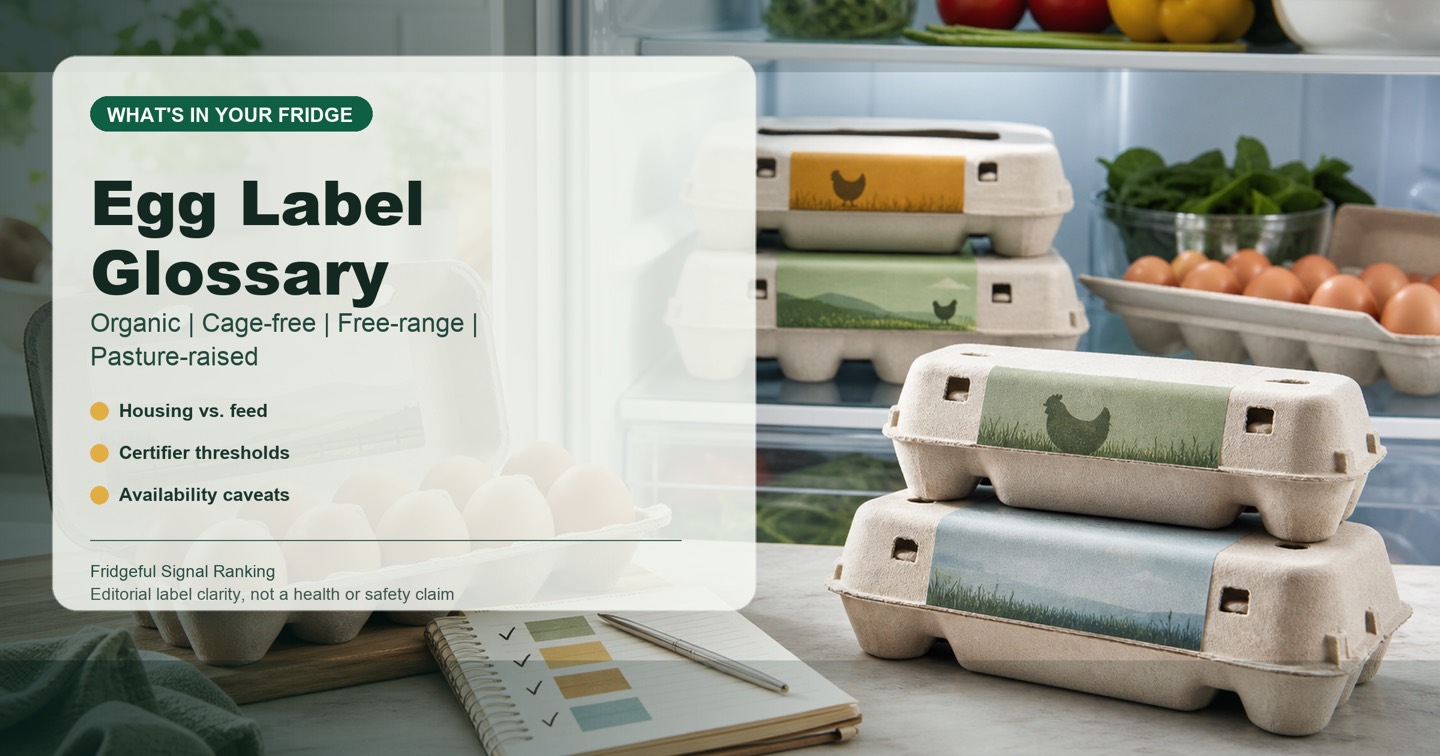
Egg Label Glossary: Organic, Cage-Free, Free-Range, Pasture-Raised
Egg labels are easiest to read when you separate housing, feed, certifier standards, safety handling, and real availability evidence instead of treating every carton phrase as the same promise.
- Published
- Category
- Eggs
- Sources
- 14 cited
The short version
Egg labels are not a ladder where every step means the same thing, only better. "Cage-free" and "free-range" are housing claims. "Organic" is a certified production system with feed, handling, and livestock-living-condition rules. "Pasture-raised" is most useful when a carton also names a third-party standard, because the phrase alone is not the same as a USDA organic rule.
Use this as the glossary hub. For narrower dives, Fridgeful has separate memos on organic free-range versus pasture-raised eggs, cage-free organic tradeoffs, store-brand egg transparency, and carton traceability claims.
Start with USDA's shell-egg baseline. The USDA shell egg Q&A says cage-free eggs in USDA grademarked consumer packages come from hens that can move vertically and horizontally inside a house, with food, water, litter, protection, and enrichments such as scratch areas, perches, and nests. The same USDA page says free-range grademarked packages add continuous outdoor access during the laying cycle, while still allowing housing systems to vary. USDA also says it does not have definitive scientific data showing a nutrition difference from hen housing. That is the first shopping rule: do not convert a housing label into a nutrition claim.
What cage-free actually tells you
Cage-free is an indoor-space signal. It does not mean the hen went outside. It also does not automatically mean USDA verified the claim, because USDA grading is voluntary. The USDA page on cage-free verification for graded shell eggs explains that USDA grading and certification services are voluntary, fee-for-service programs. So the shopper question is not just "does the carton say cage-free?" It is "who verified the claim, and is there a USDA grademark or a third-party seal?"
That matters because cage-free identifies an indoor housing system with more movement than conventional cages. It is not a pasture claim, not an organic feed claim, and not an outdoor-access claim unless the carton has another standard attached.
What free-range adds
Free-range adds outdoor access, but the minimum can depend on the standard behind the carton. USDA's grademarked free-range definition is about hens having continuous outdoor access during the laying cycle. It does not give the same shopper-friendly acreage number that some certifiers publish.
Certified Humane is more specific. Its egg-label explainer says Certified Humane Free Range requires two square feet per bird and at least six outdoor hours per day when weather permits, and its range requirements repeat the two-square-foot free-range threshold. Pete & Gerry's repeats that threshold on its Organic Free Range Eggs page, which says the eggs are USDA Certified Organic and Certified Humane Free Range, audited by separate third parties, and later defines its free-range standard as a minimum of two square feet per hen of pasture.
That is why free-range cartons are easiest to compare when the carton names a certifier. Without that extra layer, "outdoor access" may be true but hard to evaluate.
What organic adds, and what it does not
USDA Organic is not just an outdoor phrase. Current organic poultry rules sit in the National Organic Program. The eCFR avian living-conditions rule requires year-round poultry living conditions that support health and natural behavior, including outdoor access, shelter, fresh air, direct sunlight, clean water, dust-bathing materials, and adequate space. It also says continuous total indoor confinement is prohibited. The same rule adds indoor density requirements, perch and dust-bathing provisions, and outdoor-space requirements, including soil and vegetation provisions and minimum outdoor-space rates for layers.
The timing caveat is important. USDA's Organic Livestock and Poultry Standards page says most organic operations had to comply by January 2, 2025, but existing layer operations have until January 2, 2029 for some outdoor stocking density, soil, and vegetation requirements. That does not make organic meaningless; it means shoppers should avoid oversimplifying it. Organic is a certified production system, but not every organic carton is automatically pasture-raised or equally transparent about outdoor space today.
Organic also should not be treated as a safety label. FDA's egg-safety page says fresh eggs with clean, uncracked shells can still contain Salmonella, requires safe-handling statements on untreated shell-egg cartons, and advises refrigeration at 40 degrees F or below. The FDA egg-safety guidance is separate from organic, cage-free, free-range, or pasture language.
What pasture-raised means on a stronger carton
Pasture-raised is not a USDA Organic category. It becomes more useful when the carton names a certifier threshold. Certified Humane's range requirements say pasture-raised systems need 2.5 acres for every 1,000 birds, which works out to 108 square feet per bird, while free-range systems need at least two square feet per bird. Vital Farms' Organic Pasture-Raised Eggs page makes the same 108-square-foot pasture claim and adds that the hens receive USDA Certified Organic supplemental feed and are raised on organic-certified farms.
That is a strong label stack because the carton language points to organic feed and farm certification plus a specific pasture-density claim. It is still not a guarantee that one store has the exact carton, size, farm source, or price you want. Availability is a separate signal.
Brand examples to read carefully
Vital Farms Organic Pasture-Raised Eggs have the clearest organic-plus-pasture stack in this comparison. The brand gives an exact organic pasture-raised product page, specific pasture-space language, and the strongest brand-level distribution evidence. Vital's fiscal 2025 Form 10-K says it offered 23 retail SKUs through more than 24,000 stores as of December 2025 and names major natural and mainstream retail relationships. That is availability evidence from a public filing, not a store-locator result, but it is not exact-SKU proof. The caveat is exact-carton reality: national brand distribution evidence does not prove every retailer stocks the organic pasture-raised dozen today.
Pete & Gerry's Organic Free Range Eggs are the clearest organic-plus-free-range example. The brand page separates USDA Organic from Certified Humane Free Range, and Kroger's public exact-product page lists the same organic and Certified Humane free-range signals. That retailer page is useful catalog evidence, but Fridgeful does not use local pickup status, ZIP-code store results, or store-locator hits as the scoring basis.
Nellie's Free Range Eggs are useful because the brand is explicit about what it is not. Nellie's FAQ says its hens follow Certified Humane Free Range standards with a minimum of two square feet per hen of pasture, and it also says the eggs are not organic because the hens receive conventional grain. Kroger's Nellie's 18-count page supports exact-product retailer catalog evidence. Certified Humane's Who's Certified page also lists all Nellie's Free-Range Eggs, which is certifier catalog evidence rather than live retail shelf-stock evidence. The tradeoff is that Nellie's is a free-range option, not an organic or pasture-raised substitute.
How to shop the glossary
Use the label words in this order. First, identify the claim type: housing, feed, pasture space, grading, or safety handling. Second, look for the verifier: USDA Organic, a USDA grademark, Certified Humane, or another named third-party standard with public criteria. Third, read the exact carton. "Organic free-range" and "organic pasture-raised" are different promises. Fourth, separate availability from quality language. A brand may be nationally relevant while the exact carton is regional, out of stock, or available only in certain pack sizes.
Store locators can help you find dinner. They should not be the main evidence for a national availability score. For this article, Fridgeful weighted public filings, brand product pages, certifier pages, and retailer catalog pages more heavily than local inventory tools.
Fridgeful Signal Ranking
This is an editorial signal ranking for selected high-information label stacks: label clarity, regulatory or certifier visibility, outdoor/feed specificity, availability evidence, and exact-carton caveats. It is not a health claim, not a safety claim, not a taste test, and not an independent farm audit.
Eligibility gate: ranked products need a public U.S. egg product or product-line page, at least one regulatory or third-party label signal tied to organic, cage-free, free-range, or pasture-raised language, and non-locator evidence for national or multi-region relevance. This ranking intentionally compares higher-information free-range, organic, and pasture examples rather than cage-free-only cartons. Store-locator hits, ZIP-code pickup inventory, and delivery-app results are excluded from the main availability score. The 100-point rubric is: label definition precision 25, regulatory or certifier clarity 20, outdoor and feed specificity 20, claim limitation disclosure 10, U.S. availability evidence quality 15, and exact-carton caveat clarity 10.
| Rank | Brand / carton | Score | Criteria scores | Why it lands there |
|---|---|---|---|---|
| 1 | Vital Farms Organic Pasture-Raised Eggs | 86 | 23/18/20/8/13/4 | Strongest organic-plus-pasture stack and strongest brand-level distribution evidence; exact organic carton stock remains retailer- and region-specific. |
| 2 | Pete & Gerry's Organic Free Range Eggs | 81 | 22/20/16/9/8/6 | Best organic-plus-free-range explanation with separate audit language and retailer catalog evidence; less complete pasture and distribution evidence than Vital. |
| 3 | Nellie's Free Range Eggs | 67 | 18/17/12/10/6/4 | Clear Certified Humane Free Range and explicit non-organic caveat; weaker organic/pasture stack by design in this selected label-stack ranking. |
Sources
- Questions and Answers: USDA Shell Egg Grading Service. USDA Agricultural Marketing Service. Accessed 2026-06-12.
- 7 CFR 205.241: Avian living conditions. Electronic Code of Federal Regulations. Accessed 2026-06-12.
- Organic Livestock and Poultry Standards. USDA Agricultural Marketing Service. Accessed 2026-06-12.
- Which Type Of Egg Is Best?. Certified Humane. Accessed 2026-06-12.
- Range Requirements. Certified Humane. Accessed 2026-06-12.
- Cage-Free Verification Of USDA Graded Shell Eggs. USDA Agricultural Marketing Service. Accessed 2026-06-12.
- What You Need to Know About Egg Safety. U.S. Food and Drug Administration. Accessed 2026-06-12.
- Organic Pasture-Raised Eggs. Vital Farms. Accessed 2026-06-12.
- Fiscal 2025 Form 10-K. Vital Farms, Inc.. Accessed 2026-06-12.
- Organic Free Range Eggs. Pete & Gerry's. Accessed 2026-06-12.
- Pete & Gerry's Organic Free Range Large Eggs. Kroger. Accessed 2026-06-12.
- Nellie's Free Range Eggs: Frequently Asked Questions. Nellie's Free Range. Accessed 2026-06-12.
- Nellie's Free Range Eggs Large 18 ct. Kroger. Accessed 2026-06-12.
- Who's Certified. Certified Humane. Accessed 2026-06-12.