Extra-virgin olive oil freshness signals
A harvest date, protected package, named origin, and credible testing trail can make an olive oil easier to evaluate—but only the code on the bottle can describe that individual lot.
- Published
- Category
- Oils and fats
- Sources
- 24 cited
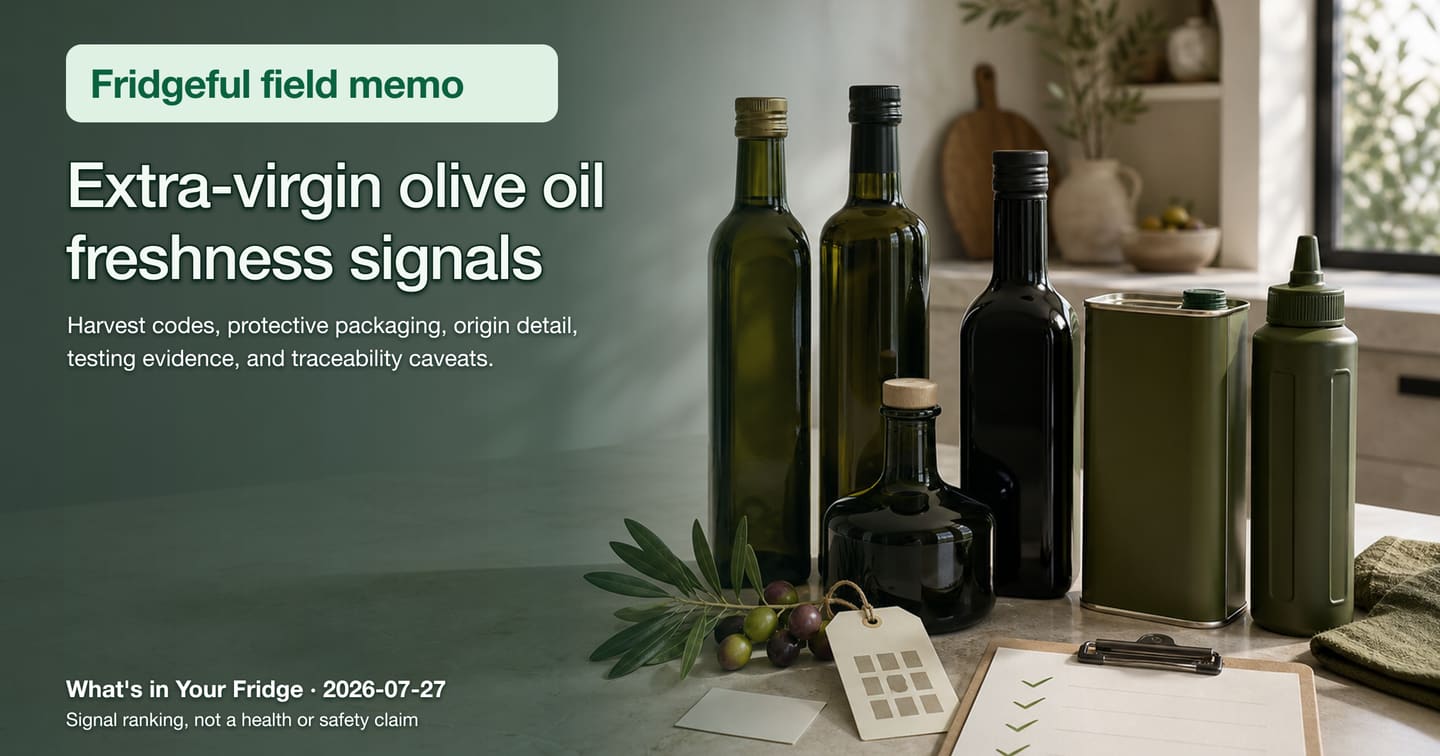
Extra-virgin olive oil does not improve with age. Light, heat, oxygen, time, and poor storage can erode the qualities that made an oil extra virgin when it was tested. That makes “freshness” a useful shopping question, but not an answer a website can provide for the bottle already in your hand. A current harvest year, dark package, named origin, and credible testing program are signals. They cannot reveal how a retailer stored one unit, whether its seal stayed intact, or how quickly a household will use it after opening.
This Fridgeful comparison ranks six exact U.S.-market products by the public trail a shopper can audit before buying. It does not taste the oils or independently test them. It also does not turn “organic,” “high polyphenol,” an award, a best-by date, or a brand's use of “cold pressed” into proof of freshness. USDA's olive-oil grade standard defines U.S. Extra Virgin through sensory and chemical requirements, while the International Olive Council maintains a broader collection of standards and analysis methods. Neither substitutes for evidence about the individual retail lot.
What counts as a freshness signal
The best public signal begins with time. A harvest date refers to when the fruit was picked; a bottling date refers to packaging; and a best-by date is the producer's shelf-life estimate. They answer different questions. A current harvest disclosed on an exact product page is useful, but a harvest or lot code printed on the physical package is stronger because it can travel with that unit. When a brand supplies a working QR or lot lookup, Fridgeful gives more credit if it can return harvest, milling, analysis, and bottling details rather than a generic brand story.
Packaging is next. The California Olive Oil Council's buying tips recommend protection from light and point shoppers toward dark glass, tin, or bag-in-box formats. The same guidance says to keep oil away from light, air, and heat. That does not make every tin fresher than every bottle: oxygen in the headspace, cap design, fill date, handling, and time after opening still matter. This ranking scores what the package appears designed to protect, not the unseen condition of its contents.
Origin and production detail help a shopper test whether claims fit together. Named countries, regions, cultivars, harvest windows, and milling intervals make a product easier to audit. Certification and testing can add another layer, but program scope matters. COOC certification is tied to a harvest and includes chemical and sensory review; its certified-oils directory is more useful than an undated seal image. The NAOOA certified list represents a recurring retail-monitoring program, not a promise that every bottle was individually sampled. Manufacturer claims of third-party testing receive less credit when no public certificate identifies the exact product or lot.
Six exact products, read cautiously
1. Terra Delyssa Organic Extra Virgin Olive Oil, 34 fl oz — 93. Terra Delyssa leads because the public trail can connect the package to a specific supply-chain record. Target's exact one-liter listing identifies a dark-glass, Tunisian, USDA Organic product with UPC 6191509903023. The brand's exact product page directs shoppers to scan a label QR, and its traceability page explains the lot-code step. The NAOOA also lists Terra Delyssa Organic EVOO in its certified set. Those are unusually strong public signals. The score still stops short of certainty because the harvest date and analysis for one unit cannot be known until its actual code is entered, and repeated program testing is not bottle-by-bottle certification.
2. Cobram Estate California Select, 375 mL — 91. Cobram's exact California Select page names a 375 mL product from California, while Target's exact retail page identifies UPC 852696002369 and Sacramento Valley production. Cobram says its olives are crushed within four to six hours, its oil is protected from oxygen during storage and capping, and its bottles carry harvest and batch-specific Best Before information. The current COOC directory has a CECA Select entry, which supports the program trail. A shopper should still compare the seal name and harvest year on the physical Target bottle with the directory; the similarity between “California Select” and “CECA Select” should not be resolved by assumption.
3. Kosterina Organic Everyday EVOO Tin, 500 mL — 87. The exact 500 mL tin page names a December 2025 harvest, a Peloponnese origin, organic Koroneiki olives, early harvest, and opaque metal packaging. Target's exact product path establishes the U.S. retail SKU and July 27 assortment. Kosterina says the oil is third-party tested and publishes product-level polyphenol language, but the accessible page does not attach a laboratory certificate to this UPC or every lot. Its FAQ and product copy also make broad health, “superfood,” heat, and superiority comparisons. Those statements are outside this ranking and reduce claim-discipline points; they do not erase the unusually clear harvest and package disclosure.
4. California Olive Ranch 100% California, 16.9 fl oz — 82. Target's exact product page identifies UPC 850687110505, dark protective glass, California origin, Applied Sensory language, and a Smart Label capable of returning harvest year, bottle date, and selected chemistry. California Olive Ranch's Smart Label explanation says the QR can reveal source detail for the bottle in hand. The back-label lot and Best By code improve traceability, and the brand describes nitrogen protection during capping. Fridgeful did not find this exact SKU in the current COOC certified-oils directory, so it does not convert general “always certified” language or OOCC membership into current COOC seal credit. The physical QR is the right place to settle the actual harvest and bottling dates.
5. Brightland Alive, 375 mL — 80. Brightland's exact Alive page is the clearest current-harvest page in the group: October 2025, 375 mL UV-coated glass, California Central Coast and Valley sourcing, Arbosana and Koroneiki cultivars, and milling within hours. That earns full coding and origin-detail points even without a retailer barcode. Brightland also says its oils are lab-tested at bottling, but the public page does not expose a lot-specific certificate or a recognized current olive-oil program seal for Alive. Its nutrition and quality copy travels beyond what this public-evidence review can verify. Direct nationwide sales support access, while the lack of a stable exact retailer identifier limits the SKU trail.
6. Graza Drizzle, 500 mL — 59. Graza's Drizzle page says the finishing oil uses early olives harvested in October, and the brand's harvest-date explanation says the date is printed on each bottle. Target's exact listing supplies UPC 195893693672 and identifies a recyclable plastic squeeze bottle. The tradeoffs are material. Graza's FAQ allows limited Koroneiki from Portugal or Coratina from Italy in addition to its usual Picual from Jaén, so the physical label must settle origin and cultivar. The public evidence does not show a recognized testing-program listing or exact certificate, and protective claims made for Graza's glass or refill packages cannot simply be transferred to this squeeze SKU. Broad freshness, health, and superiority copy receives no claim-discipline credit.
Fridgeful Signal Ranking
This is an editorial ranking of public freshness signals. It is not a health claim, not a safety finding, not an authenticity determination, not a fraud investigation, not a taste test, and not a promise that a particular bottle is fresh.
Eligibility requires an exact current extra-virgin olive oil sold to U.S. consumers, a stable official or retailer path, and enough evidence to review coding, packaging, production, testing, and traceability. The 100-point rubric is: harvest and freshness coding 25; package protection 20; origin, cultivar, harvest, and milling detail 20; current certification and testing evidence 15; exact-SKU traceability and availability 15; and claim discipline 5. Criteria scores below follow that order.
| Rank | Exact product | Score | Criteria scores | Best evidence-led read |
|---|---|---|---|---|
| 1 | Terra Delyssa Organic EVOO, 34 fl oz | 93 | 23/18/18/15/15/4 | Strongest physical-bottle harvest, analysis, and supply-chain lookup. |
| 2 | Cobram Estate California Select, 375 mL | 91 | 22/20/17/14/13/5 | Current COOC evidence plus strong dating and package controls. |
| 3 | Kosterina Organic Everyday EVOO Tin, 500 mL | 87 | 25/20/19/9/13/1 | Current named harvest in an opaque exact-SKU tin. |
| 4 | California Olive Ranch 100% California, 16.9 fl oz | 82 | 21/19/15/8/15/4 | Detailed bottle Smart Label, with certification-scope caveats. |
| 5 | Brightland Alive, 375 mL | 80 | 25/18/20/5/10/2 | Excellent harvest and production disclosure; thin public certification trail. |
| 6 | Graza Drizzle, 500 mL | 59 | 20/12/14/2/11/0 | Useful harvest coding, but weaker package, origin, and testing evidence. |
What the physical bottle must settle
Before buying, photograph the front, back, cap, harvest or best-by date, lot code, seal, size, UPC, store, and price. Scan the QR while the bottle is still returnable. Confirm that the result names the same product and exposes real lot information rather than redirecting to generic marketing. For a COOC-marked oil, match the producer, product, and harvest to the current directory. For a NAOOA-listed brand, remember that program participation strengthens the market-monitoring signal but does not identify the test history of your unit.
After opening, record the date and store the package closed in a cool, dark cabinet away from the stove. A smaller protected package can be a more useful household choice than a larger one that remains open for months, but this article does not calculate an ideal consumption window for every kitchen. Fridgeful's durable record is the exact bottle and its code—not the ranking position alone.
Sources
- Olive Oil and Olive-Pomace Oil Grades and Standards. USDA Agricultural Marketing Service. Accessed 2026-07-27.
- IOC Standards, Methods and Guides. International Olive Council. Accessed 2026-07-27.
- Buying Tips. California Olive Oil Council. Accessed 2026-07-27.
- Certified Oils. California Olive Oil Council. Accessed 2026-07-27.
- CECA Select. California Olive Oil Council. Accessed 2026-07-27.
- NAOOA Certified Olive Oil. North American Olive Oil Association. Accessed 2026-07-27.
- Terra Delyssa 100% Organic Extra Virgin Olive Oil - 34 fl oz. Target. Accessed 2026-07-27.
- Organic Extra Virgin Olive Oil, 1L. Terra Delyssa. Accessed 2026-07-27.
- Traceability. Terra Delyssa. Accessed 2026-07-27.
- Terra Delyssa - Certified Olive Oil. North American Olive Oil Association. Accessed 2026-07-27.
- Cobram Estate California Select Extra Virgin Olive Oil - 375ml. Target. Accessed 2026-07-27.
- California Select. Cobram Estate USA. Accessed 2026-07-27.
- Explore Our Select California Olive Oil. Cobram Estate. Accessed 2026-07-27.
- Organic Everyday Extra Virgin Olive Oil Tin, 500ml. Kosterina. Accessed 2026-07-27.
- Kosterina Organic Everyday Olive Oil - 500ml. Target. Accessed 2026-07-27.
- FAQs. Kosterina. Accessed 2026-07-27.
- California Olive Ranch 100% CA Extra Virgin Olive Oil - 16.9 fl oz. Target. Accessed 2026-07-27.
- 100% California. California Olive Ranch. Accessed 2026-07-27.
- Introducing Our New Smart Labels. California Olive Ranch. Accessed 2026-07-27.
- Alive Extra Virgin Olive Oil. Brightland. Accessed 2026-07-27.
- Graza Drizzle Extra Virgin Olive Oil for Finishing - 500ml. Target. Accessed 2026-07-27.
- Drizzle Olive Oil. Graza. Accessed 2026-07-27.
- FAQs. Graza. Accessed 2026-07-27.
- My Sizzle Is a Scorpio: Single Origin and Varietal. Graza. Accessed 2026-07-27.