How long to keep leftovers in the fridge
The three-to-four-day rule only works when leftovers were cooled promptly, stayed at 40°F or below, and still have a trustworthy time-and-temperature history.
- Published
- Category
- Expiration and use-soon planning
- Sources
- 10 cited
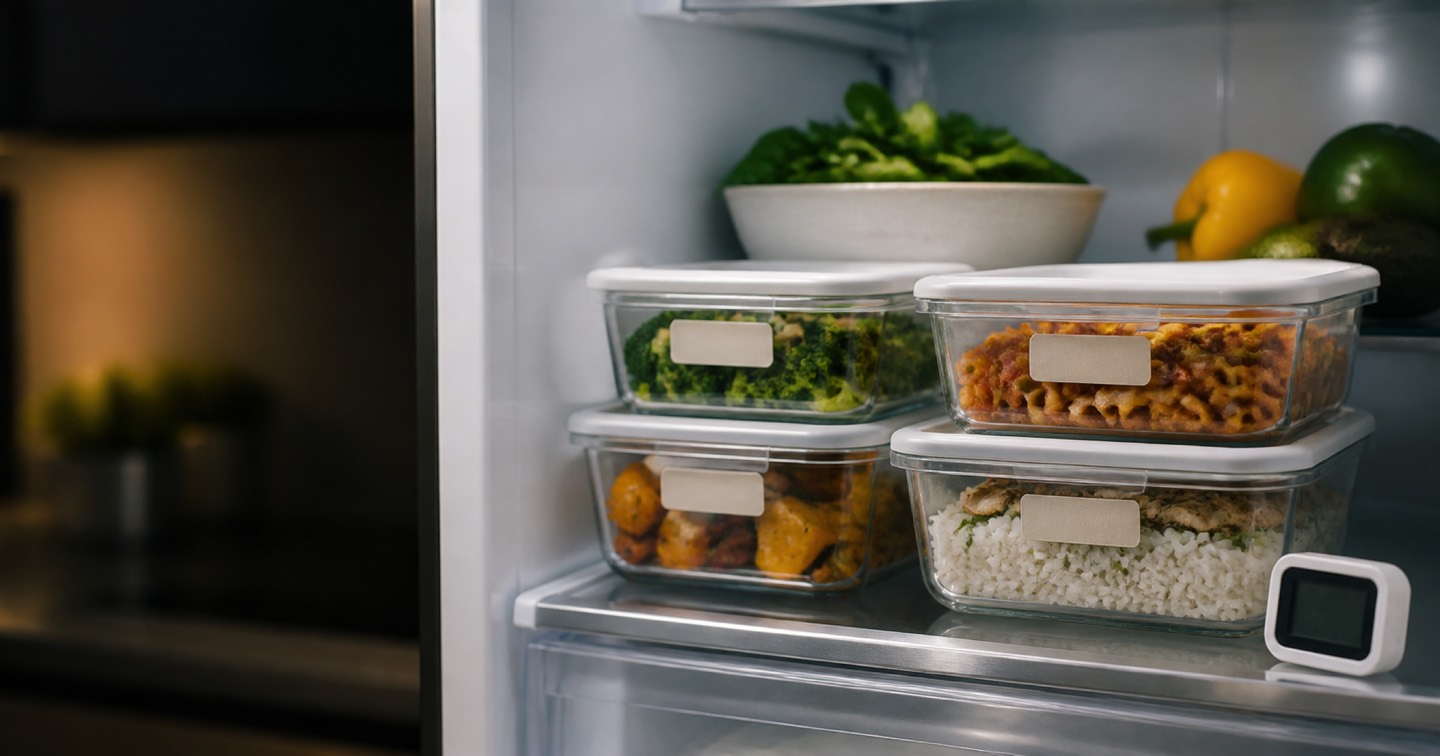
Most cooked leftovers should be eaten or frozen within three to four days. That answer assumes the food was refrigerated within two hours of cooking or serving—within one hour when the air temperature was above 90°F (32°C)—and then stayed at 40°F (4°C) or below. Store it in covered, shallow containers so it cools quickly. When reheating, bring the food to 165°F (74°C) as measured with a food thermometer. If you cannot trust its time or temperature history, discard it rather than restarting the clock.
That is the answer-first rule from USDA's Leftovers and Food Safety guidance. It is a ceiling, not a promise that every forgotten container remains safe until the end of day four.
When does the leftover clock start?
Start tracking when the food stops being held hot and enters the cooling-and-storage workflow. Perishable food should reach the refrigerator or freezer within two hours; use the one-hour limit when the surrounding temperature is above 90°F. The federal 4 Steps to Food Safety page explains why: bacteria multiply fastest between 40°F and 140°F, and prompt chilling limits time in that range.
Do not leave a stockpot on the counter until it feels cold. USDA says hot food can go directly into the refrigerator, and large batches should be divided into shallow containers or smaller portions. The refrigerator then has less mass to cool. Cover or seal the portions, label the cooked-on date, and avoid packing the refrigerator so tightly that cold air cannot circulate.
A practical household rule is: write the date when you put the leftovers away, then assign an eat-or-freeze decision no later than day four. Choose the earlier edge of the window when the exact time is unclear. A digital expiration-reminder workflow can surface that decision, while a fridge inventory can show the container before meal planning or shopping. Neither tool can verify the food's temperature or make an unsafe container safe.
The three-to-four-day rule and its exceptions
The FoodSafety.gov Cold Food Storage Chart lists cooked meat or poultry leftovers, pizza, chicken nuggets, egg casseroles, soups, and stews at about three to four refrigerator days when held at 40°F or below. Some entries differ: quiche is listed at three to five days, hard-cooked eggs at one week, and some seafood categories have their own shorter ranges. Use the item's specific entry rather than stretching the general rule.
The clock is also overridden by handling history. Food left at room temperature beyond the two-hour limit—or one hour above 90°F—should be discarded, even if it was cooked today. A refrigerator that ran warm, a long restaurant trip home, or an unknown cooked-on date can make “day two” meaningless. The USDA's updated cooked-food refrigerator answer stresses that refrigeration slows bacterial growth but does not stop it.
For more specific foods, FoodKeeper provides item-level storage guidance developed by USDA FSIS with Cornell University and the Food Marketing Institute. Package handling directions and active recall advice also take priority over a general leftover rule.
Five leftover-storage controls, ranked
1. Label, chill, and use-or-freeze workflow — 96. Portion food promptly into covered shallow containers, mark the cooked-on date, verify the refrigerator is at or below 40°F, and decide to eat or freeze it within three to four days. This is the most complete workflow because the date, temperature assumption, and next action stay together.
2. Freeze-by-decision workflow — 91. If a portion is not realistically on the next few meals, freeze it early instead of waiting until the refrigerator deadline. USDA says frozen leftovers remain safe indefinitely when continuously frozen, although quality declines; its general leftovers page gives three to four months as a practical quality window. The federal chart varies by food—for example, pizza, soup, and cooked meat have different ranges—so label the frozen date and check the specific item.
3. Dated eat-first bin plus refrigerator thermometer — 86. Put labeled leftovers together on a visible shelf and check an appliance thermometer. FDA's refrigerator thermometer guidance says the refrigerator should be 40°F or below and recommends shallow containers for faster cooling. Visibility helps prevent waste; the thermometer tests whether the date-based plan has a valid cold-storage foundation.
4. Calendar reminder without temperature verification — 58. A reminder solves forgetting, but not food safety. It does not establish when a container was cooled, whether the refrigerator remained cold, or whether it sat in a warm car. Use reminders as prompts attached to a reliable cooked-on date—not as countdown certificates.
5. Smell-and-memory-only check — 20. Odor and appearance can reveal spoilage, so suspicious food belongs in the trash. But FDA's safe-storage guidance warns that food can cause illness even when it does not look, smell, or taste spoiled. A normal smell cannot prove a safe timeline, and tasting is not a safety test.
Fridgeful Signal Ranking
This is an editorial ranking of household controls, not a health claim, laboratory test, food-safety certification, or judgment that a specific leftover is safe to eat.
| Rank | Storage control | Score | Criteria scores | What it controls |
|---|---|---|---|---|
| 1 | Label, chill, and use-or-freeze workflow | 96 | 30/24/20/14/8 | Time, temperature, cooling, next action, and uncertainty. |
| 2 | Freeze-by-decision workflow | 91 | 28/23/18/15/7 | Early freezing, portioning, thawing, and reheating plan. |
| 3 | Dated eat-first bin plus refrigerator thermometer | 86 | 29/25/17/7/8 | Visible deadline and verified cold storage. |
| 4 | Calendar reminder without temperature verification | 58 | 25/5/10/10/8 | The date prompt, but not the complete storage history. |
| 5 | Smell-and-memory-only check | 20 | 4/2/2/2/10 | Spoilage warning only; it cannot establish safety. |
Criteria scores follow the article data: time control 30; temperature control 25; cooling and storage 20; freeze, thaw, and reheat plan 15; claim discipline and discard rule 10.
Freeze, thaw, and reheat without resetting history
Freeze a leftover while its refrigerator history is still trustworthy. Freezing does not repair food that spent too long warm, and reheating later does not erase earlier mishandling. Label the food and date, freeze useful portions, and thaw in the refrigerator, in cold water, or in the microwave—not on the counter. USDA says microwave-thawed leftovers should continue heating to 165°F.
Reheat leftovers to 165°F measured with a food thermometer. Bring sauces, soups, and gravies to a rolling boil. Cover and rotate microwave dishes, then check several places because microwaves can leave cold spots. USDA's restaurant-leftover guidance also cautions against using a slow cooker to reheat because food may remain too long in the 40°F-to-140°F range.
What to do after a power outage or warm-fridge event
The day label is not enough after a temperature failure. FoodSafety.gov's power-outage chart says an unopened refrigerator keeps food safe for up to about four hours. After four hours without power, discard refrigerated perishable foods including leftovers. The same chart says to discard leftover meat, poultry, fish, casseroles, soups, stews, cooked rice, pasta, and potatoes when they have been above 40°F for more than two hours.
If you measured that food remained at 40°F or below, the ordinary timeline can continue. If you do not know how long it was warm, do not use smell or a quick reheat to fill the evidence gap. Discard it. Frozen food can be refrozen or cooked when it still contains ice crystals or measures 40°F or below, although quality may change.
Anyone can get food poisoning, but the CDC identifies higher-risk groups: adults 65 and older, children under five, pregnant people, and people with weakened immune systems. When serving someone in one of these groups, avoid improvising around an unknown timeline and follow their specific public-health guidance.
The durable routine is simple: cool promptly, date the container, keep the refrigerator at 40°F or below, eat or freeze within three to four days, and reheat to 165°F. When the history cannot support that chain, the safe decision is to discard.
Sources
- Leftovers and Food Safety. USDA Food Safety and Inspection Service. Accessed 2026-08-09.
- Cold Food Storage Chart. FoodSafety.gov. Accessed 2026-08-09.
- How long will cooked food stay safe in the refrigerator?. USDA Food Safety and Inspection Service. Accessed 2026-08-09.
- FoodKeeper App. FoodSafety.gov. Accessed 2026-08-09.
- Refrigerator Thermometers - Cold Facts about Food Safety. U.S. Food and Drug Administration. Accessed 2026-08-09.
- Are You Storing Food Safely?. U.S. Food and Drug Administration. Accessed 2026-08-09.
- 4 Steps to Food Safety. FoodSafety.gov. Accessed 2026-08-09.
- Food Safety During Power Outage. FoodSafety.gov. Accessed 2026-08-09.
- People at Increased Risk for Food Poisoning. Centers for Disease Control and Prevention. Accessed 2026-08-09.
- 10 Smart Tips to Keep Your Restaurant Leftovers Safe. USDA Food Safety and Inspection Service. Accessed 2026-08-09.