Sourdough claims and fermentation signals
A sourdough name is only the beginning. The strongest public signal combines an exact package, a named starter or culture, disclosed added yeast and acids, a product-tied process statement, and a formula that agrees across current sources.
- Published
- Category
- Grains and bread
- Sources
- 21 cited
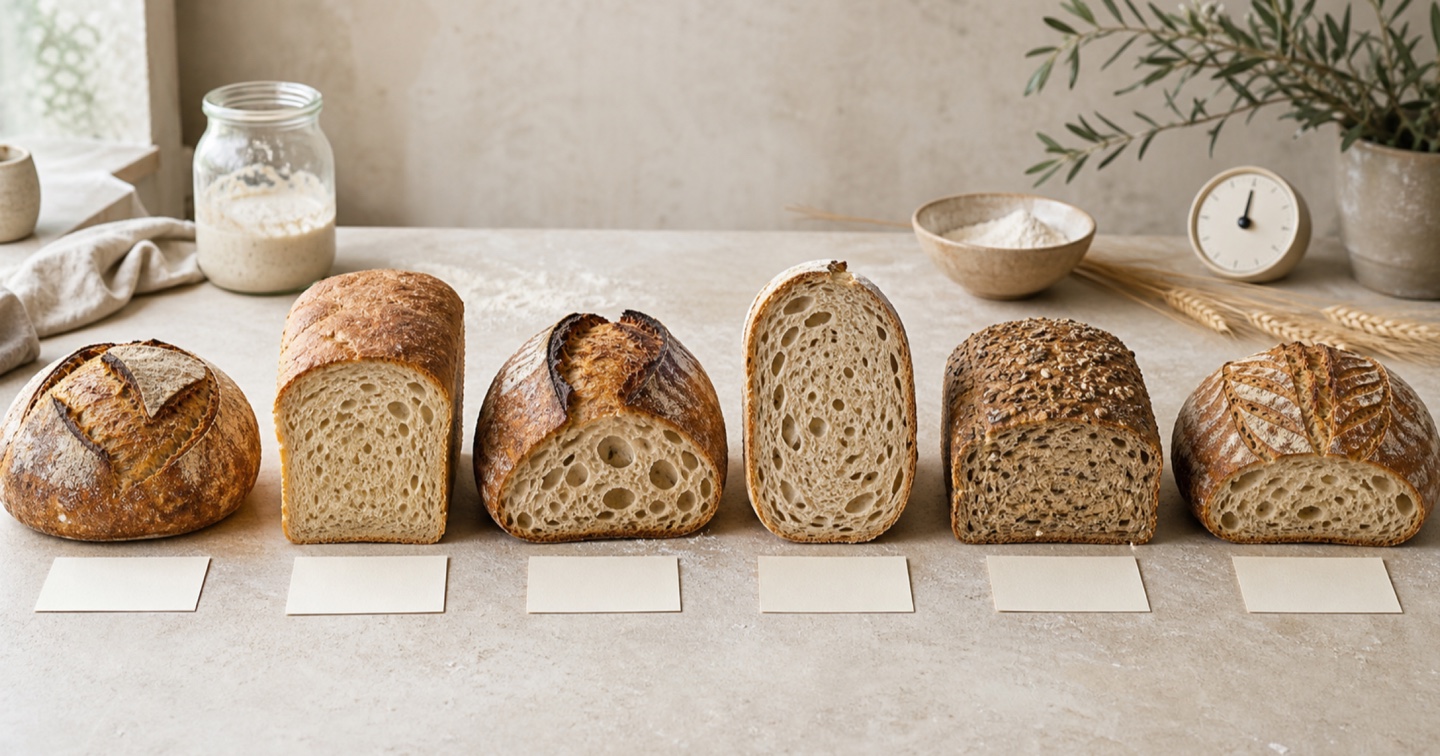
“Sourdough” on the front of a packaged loaf does not tell shoppers how its dough was fermented. The useful public signals are more specific: does the exact ingredient list name a starter, culture, or fermented flour; does it separately disclose baker's yeast, vinegar, or added acids; does the producer publish a time or process statement tied to the loaf; and do the official and retailer versions of the label agree?
That is all this comparison measures. It does not rank health, digestibility, glycemic response, gluten tolerance, taste, safety, artisan quality, or overall bread superiority. Added commercial yeast is not an automatic failure, and its absence is not proof of a long fermentation. A recent review describes sourdough broadly as flour-and-water dough fermented through yeasts and lactic acid bacteria. FDA's ingredient guidance also matters because packaged-food ingredients appear in descending order by weight. Neither source lets a shopper reconstruct time, temperature, acidity, or microbial activity from an ingredient list alone.
On the evidence visible July 27, Rudi's Organic Rocky Mountain Sourdough has the strongest exact-product fermentation disclosure. Izzio supplies stronger starter naming and flour traceability but has unresolved label conflicts. The current 365 private-label loaf names a flour-and-water culture cleanly but publishes no duration. Nature's Own provides an unusually current and complete formula without a process time. Boudin publishes strong mother-dough history but leaves its exact sliced-product label largely invisible online. Pepperidge Farm offers the clearest warning against equating “slow bake” with fermentation.
How the scoring works
The 100-point rubric gives 25 points to starter or culture naming, 15 to clear disclosure of added yeast and acids, 20 to product-tied fermentation or process evidence, 20 to exact label and Nutrition Facts identity, 15 to traceability and current availability, and 5 to claim discipline.
This is deliberately a disclosure ranking. A producer may use a process it does not explain online; that hidden process cannot earn public-evidence points. Conversely, a named culture does not establish how much was used, how long the final dough fermented, whether separately added yeast supplied most of the rise, or what organisms remained active later. A short formula is easier to audit, but short does not mean healthier or better.
The cited federal bread regulation describes bread, rolls, buns, leavening agents, and optional ingredients. It does not provide this article's editorial scoring system or a fermentation-duration test for the word “sourdough.” Treat the ranking as a reproducible comparison of public evidence, not a legal authenticity ruling.
Six exact package reads
1. Rudi's Organic Rocky Mountain Sourdough — 84. Rudi's exact product page says its starter has been maintained since 1980, that more yeast is added, and that every batch bubbles for 24 hours. This is the only exact-product statement in the set that supplies a numeric fermentation duration rather than “slow,” “long,” or a total manufacturing window.
The official formula names organic dehydrated rye sourdough containing rye flour, barley malt syrup, and sourdough culture. It separately lists yeast and vinegar. That candor matters: commercial yeast is visible rather than concealed, and the 24-hour claim is not presented as yeast-free fermentation.
The package record is less tidy. Target's exact 22-ounce listing identifies UPC 031493317511 and gives a complete Nutrition Facts panel, but its sourdough sub-ingredients differ from Rudi's current page. Target says fermented rye flour and salt; Rudi's says rye flour, barley malt syrup, and sourdough culture. The pages also differ between cultured wheat starch and cultured wheat flour. Rudi's says the physical label is authoritative when formulas change. That conflict limits the score to 84.
2. Izzio San Francisco Style Sourdough Sliced Batard — 77. Izzio's exact page names its original mother sourdough and lists “Sourdough Culture (Wheat Flour, Water).” It also says the sliced loaf is slowly fermented and small-batch baked. Izzio's broader process page says its custom flour is traceable to the mill.
The limitation is material. Izzio's official page lists flour, culture, water, salt, and enzymes, with 140 calories, 290 milligrams of sodium, and 5 grams of protein per two slices. Target's exact UPC page lists flour, water, salt, culture, and enzymes, with 120 calories, 240 milligrams of sodium, and 4 grams of protein. Ingredient order matters, and those nutrition differences should not be merged silently. Izzio also publishes broad digestibility, microbiome, glycemic, and gluten-reduction marketing claims. This comparison does not treat them as established outcomes, producing the lowest claim-discipline score in the set.
3. 365 Organic Sourdough Bread — 74. The current 365 Organic Sourdough Bread is a different product from the older 18-ounce Organic Sourdough Sandwich Bread still circulating on delivery sites. The current 24-ounce listing, ASIN B0DPXKXV31, gives organic wheat flour, organic sourdough culture made from organic wheat flour and water, water, sea salt, and enzymes. It does not separately list baker's yeast, vinegar, or added acids.
That is strong exact culture and formula evidence, but not proof of duration or exclusive natural leavening. The page publishes no fermentation time or detailed process. Its accessible text also omits a complete Nutrition Facts panel and public UPC. The active Whole Foods purchase path supports availability, while disciplined claims but limited process and package identifiers hold the score at 74.
4. Nature's Own Perfectly Crafted Thick Sliced Sourdough — 73. Nature's Own says this 22-ounce loaf now has a simpler recipe. The brand's current ingredient module and Kroger's exact UPC page agree on wheat flour, water, yeast, rye sourdough made from water, fermented rye flour, and salt, plus wheat sourdough made from water and fermented wheat flour. The formula clearly lists vinegar, cultured wheat flour, oil, sugar, gluten, and enzymes.
The sourdough components are named, and commercial yeast is third rather than obscured. The exact page supplies 15 slices, a 42-gram serving, 110 calories, and UPC-A 072250916615. Neither the exact product nor brand page states a fermentation duration or describes how the rye and wheat sourdough components interact with the final dough. Fermented flour establishes an ingredient identity, not a final-loaf timeline.
5. Boudin Lunchbox Sourdough Sliced Loaves — 64. Boudin's exact two-loaf product is unusually specific as a direct-sale SKU: 768, two 22-ounce loaves, $24.95, and a current shipping date. The page identifies them as sliced Original San Francisco Sourdough.
Boudin's bread-process page says its mother dough contains wild yeast and lactobacillus, that its sourdough rises without commercial yeast, and that a portion starts every batch. It also says handcrafted loaves take up to 72 hours from scratch to finish. That is useful quantitative process evidence, but it does not say fermentation alone lasts 72 hours. The exact SKU page publishes no ingredient panel, Nutrition Facts, allergen panel, or UPC. Brand-wide process evidence cannot fully replace the shipped package.
6. Pepperidge Farm Farmhouse Sourdough — 45. Pepperidge Farm's official page emphasizes slow baking. Baking occurs after dough development, so that phrase earns no fermentation-process points. Its accessible official formula lists commercial yeast, lactic acid, and citric acid but no starter, culture, or fermented flour.
The current Target page for UPC 014100074670 is different. It lists fermented wheat flour after yeast and gives 270 milligrams of sodium, 4 grams of total and added sugar, and 5 grams of protein per slice. The official page reports 230 milligrams of sodium, 2 grams of added sugar, and 4 grams of protein, with a materially different ingredient sequence. The exact product is current and both sources disclose yeast and acids, but neither supplies fermentation time.
Fridgeful Signal Ranking
This is a ranking of public formula, fermentation, identity, and availability signals. It is not a health claim, not a digestion or blood-sugar finding, not a gluten-tolerance judgment, not a food-safety claim, not a taste test, and not a legal ruling about what counts as sourdough.
| Rank | Exact product | Score | Criteria scores | Best evidence-led read |
|---|---|---|---|---|
| 1 | Rudi's Organic Rocky Mountain Sourdough | 84 | 22/12/20/13/13/4 | Only exact loaf here with a numeric 24-hour batch statement. |
| 2 | Izzio San Francisco Style Sourdough Sliced Batard | 77 | 25/12/12/12/15/1 | Excellent mother-culture and flour-traceability evidence; conflicting labels. |
| 3 | 365 Organic Sourdough Bread | 74 | 25/15/4/13/12/5 | Clear flour-and-water culture, without a published duration. |
| 4 | Nature's Own Perfectly Crafted Thick Sliced Sourdough | 73 | 18/15/4/19/13/4 | Best current mainstream formula identity, without time evidence. |
| 5 | Boudin Lunchbox Sourdough Sliced Loaves | 64 | 20/7/14/8/12/3 | Strong brand process; exact shipped-label evidence remains thin. |
| 6 | Pepperidge Farm Farmhouse Sourdough | 45 | 8/10/0/11/13/3 | “Slow bake” is not fermentation evidence, and online formulas conflict. |
What the physical package must settle
Rudi's, Izzio, and Pepperidge Farm have material online formula conflicts. Nature's Own explicitly advertises a new recipe, making old marketplace records risky. The older 365 18-ounce sandwich loaf must not be merged with the current 24-ounce ASIN. For all six, the bag controls ingredient, allergen, lot, best-by, and Nutrition Facts decisions.
Photograph the front, ingredient list, Nutrition Facts, UPC or SKU, lot code, and best-by date. Record whether the formula names starter, culture, sourdough, or fermented flour; whether it separately lists yeast, vinegar, lactic acid, or citric acid; and whether the producer supplies a product-specific duration. Do not turn those observations into promises about digestion, blood sugar, gluten tolerance, safety, or taste.
Sources
- Types of Food Ingredients. U.S. Food and Drug Administration. Accessed 2026-07-27.
- 21 CFR 136.110 — Bread, rolls, and buns. Electronic Code of Federal Regulations. Accessed 2026-07-27.
- Sourdough Bread Quality: Facts and Factors. PubMed Central. Accessed 2026-07-27.
- Organic Rocky Mountain Sourdough. Rudi's Bakery. Accessed 2026-07-27.
- Rudi's Organic Rocky Mountain Sourdough Bread, 22 oz. Target. Accessed 2026-07-27.
- San Francisco Style Batard. Izzio Artisan Bakery. Accessed 2026-07-27.
- Izzio San Francisco Style Sourdough Sliced Batard, 24 oz. Target. Accessed 2026-07-27.
- The Real Sourdough Difference. Izzio Artisan Bakery. Accessed 2026-07-27.
- FAQ. Izzio Artisan Bakery. Accessed 2026-07-27.
- 365 Organic Sourdough Bread, 24 oz. Whole Foods Market. Accessed 2026-07-27.
- Breads. Whole Foods Market. Accessed 2026-07-27.
- Thick Sliced Sourdough. Nature's Own. Accessed 2026-07-27.
- Thick Sliced Sourdough Ingredients. Nature's Own. Accessed 2026-07-27.
- Nature's Own Perfectly Crafted Sourdough Bread, 22 oz. Kroger. Accessed 2026-07-27.
- Nature's Own Perfectly Crafted Thick Sliced Sourdough. H-E-B. Accessed 2026-07-27.
- Lunchbox Sourdough Sliced Loaves, SKU 768. Boudin Bakery. Accessed 2026-07-27.
- The Original San Francisco Sourdough Catalog. Boudin Bakery. Accessed 2026-07-27.
- Our Bread. Boudin Bakery. Accessed 2026-07-27.
- Farmhouse Sourdough Bread. Pepperidge Farm. Accessed 2026-07-27.
- Pepperidge Farm Farmhouse Sourdough Bread, 24 oz. Target. Accessed 2026-07-27.
- Pepperidge Farm Farmhouse Sourdough Bread, 24 oz. Kroger. Accessed 2026-07-27.