Store-brand chicken traceability
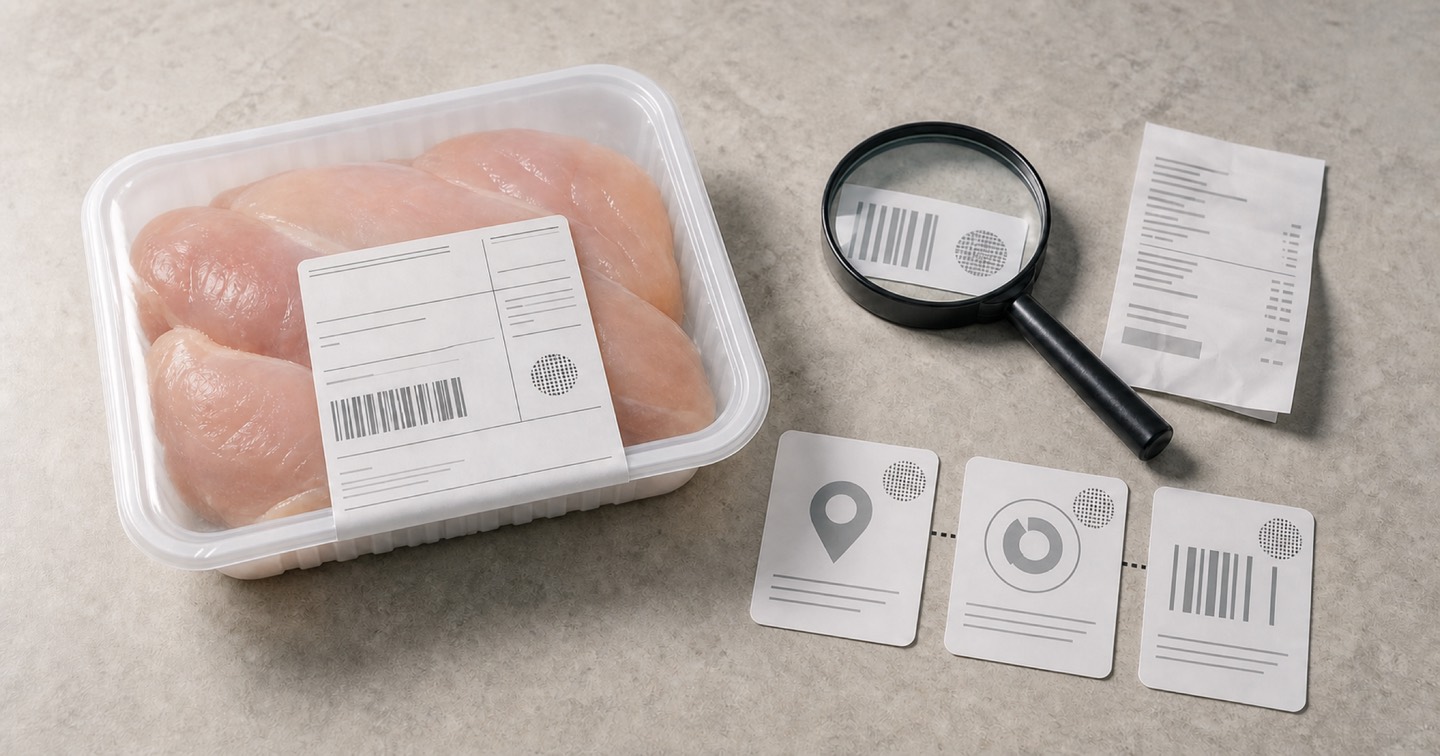
A retailer logo identifies the line, not necessarily the farm or processor; useful private-label traceability connects the exact tray to a supplier, inspected establishment, current verification record, and package code.
- Published
- Category
- Chicken
- Sources
- 15 cited
The short version
A store brand tells you who controls the label and shelf relationship. It does not necessarily tell you which farm raised the chicken, which company processed it, or whether today’s tray came through the same plant as last month’s. Useful private-label traceability is a chain: exact product, retailer-owned line, named supplier or inspected establishment, independent record, then the current package’s P-number and lot or date code.
Among the products checked, Simply Nature Organic Chicken Breasts, per lb has the strongest public chain. ALDI identifies the exact product, and Certified Humane’s current Who’s Certified directory names Shenandoah Valley Organic and explicitly includes Aldi Simply Nature organic chicken and chicken parts. That is meaningful line-level evidence, but it is not permission to print Shenandoah Valley Organic’s plant number onto every Aldi tray in your notes. The logo and P-number on the current package must agree.
365 by Whole Foods Market Organic Boneless Skinless Chicken Breast comes second. Whole Foods publishes a strong farm-traceability system, yet its public exact-product page does not name this SKU’s farm, supplier, or inspected plant. Marketside Antibiotic-Free Boneless Skinless Chicken Breasts, 1.3 - 3.0 lb provides a clear exact retail identity but no public producer, facility, certifier, or package-code trail on the pages reviewed. That makes it a useful low-transparency benchmark, not evidence of a lower-quality product.
What a private-label package can identify
The distributor line, inspection mark, country-of-origin statement, and retail item number answer different questions. Under 9 CFR 381.122, a poultry label shows the manufacturer, packer, or distributor’s name and address; when it shows only a distributor, wording such as “distributed by” qualifies that relationship. A retailer name in that field therefore need not be the farm or processing establishment.
9 CFR 381.123 separately requires the official inspection legend and establishment number on an inspected poultry product’s immediate container. The number may appear inside or near the legend, or in another stated location, and poultry numbers use a `P` prefix. The current FSIS recall guide explains why shoppers should also preserve lot codes and “best by” or “use by” dates: recalls identify affected production using a combination of product labels, dates, lot codes, and establishment numbers.
A P-number can be searched in the current FSIS Meat, Poultry and Egg Product Inspection Directory. It identifies an inspected establishment and its recorded activities, not necessarily the farm, the brand owner, every upstream supplier, or even the original slaughter plant when later processing occurred elsewhere. UPCs and retailer numbers likewise identify a catalog item: a Walmart item ID, ALDI product record, TCIN, DPCI, or UPC can stabilize the exact retail comparison without revealing who raised or processed the birds.
Origin is another layer. USDA’s Country of Origin Labeling FAQ says covered chicken muscle cuts carry production-step origin information at retail, and suppliers retain records supporting it. The disclosure may be on the package, a placard, or shelf signage. “Hatched, raised, and harvested in the U.S.” is useful country-level evidence. It is not a farm name. A lot code or use-by date narrows a production run, but it becomes traceability only when the company or a recall notice provides a lookup.
Retail cutting can complicate the visual trail. 9 CFR 381.10(d)(4) keeps adulteration and misbranding rules applicable to retail-exempt articles even though the official inspection legend requirement is excepted. That is why a store-wrapped tray may not present the same mark placement as an intact processor package. The absence of a visible P-number on an online image is not proof that the physical package lacks one.
How Fridgeful scored the evidence
This 100-point rubric uses fixed bands. Exact product identity earns 20 for a current exact raw product page with a stable retailer item identifier, 19 for a current exact variable-weight catalog record without a public package identifier, 12 for a product-family page, and zero for a generic retailer promise. Supplier or facility traceability earns 25 for an exact package-to-farm or P-number chain, 20 for a named supplier explicitly connected to the private-label line with package confirmation still outstanding, 12 for a retailer’s documented internal farm-traceability system, and zero when no supplier or facility is public.
Retailer policy linkage earns 15 for a current chicken-applicable standard tied to the exact retail system, 10 for a documented line connection, 4 for a general brand hub, and zero for none. Independent verification earns 15 for a current exact-SKU certifier record, 14 for a current certifier directory that explicitly names the private-label line, 12 for a current retailer certification system without exact-SKU directory evidence, and zero for self-description alone.
Package-code clarity earns 10 for a published exact P-number plus lot-level path, 6 when a line-to-supplier record exists but today’s mark must be checked, 5 for a retailer-required internal chain with no public number, and 1 when only the physical package might resolve it. Availability earns 10 for a reproducible exact catalog and retailer-line path, 8 for an official product path with fresh-stock variability, and zero for locator evidence alone. Claim discipline earns 5 when every supplier, certification, origin, and stock limitation is explicit.
Product-by-product evidence
Simply Nature scores 83. ALDI’s current catalog page establishes the exact private-label breast. The Certified Humane directory connects Shenandoah Valley Organic to “Aldi Simply Nature” organic chicken and parts. FSIS also publishes a current Shenandoah Valley Organic establishment page, while a March 5, 2026 AMS supplier listing documents Shenandoah Valley Organic with P-46826 in that separate program.
Those records form the best public line-level chain here, but the last step is deliberately conditional. The AMS document is not an ALDI SKU certificate, and suppliers can change. Attribute an individual tray to Shenandoah Valley Organic or P-46826 only when the current Simply Nature package carries the applicable certification logo and matching P-number.
Whole Foods 365 scores 77. The retailer’s current Meat Department Quality Standards say animal products must be traceable to farms or ranches and fresh chicken must meet an approved third-party certification system. That gives the 365 product a strong retailer-governed chain and independent controls. What the public trail does not supply is equally important: the exact breast page does not expose a named farm, supplier, P-number, lot lookup, or independently published exact-SKU certifier record. Internal traceability deserves credit, but it is not the same as shopper-reproducible origin.
Marketside scores 40. The exact page and current Marketside hub make the product and retailer line easy to identify. They do not publicly connect this breast to a producer, inspected facility, farm, certifier, or package lookup. Marketing claims printed on the listing are outside this traceability score. The product can still be fully compliant and carry useful codes on its physical tray; the point is that the online evidence does not let a shopper reproduce that chain before purchase.
Fridgeful Signal Ranking
This is an editorial ranking of public private-label traceability evidence. It is not a health claim, food-safety ranking, welfare comparison, organic explainer, antibiotic assessment, air-chilling comparison, taste test, value ranking, or guarantee of local stock.
Criteria scores follow this order: exact product identity / supplier or facility traceability / retailer policy linkage / independent verification / package-code clarity / availability evidence / claim discipline.
| Rank | Exact product | Score | Criteria scores | Best shopper read |
|---|---|---|---|---|
| 1 | Simply Nature Organic Chicken Breasts, per lb | 83 | 20/20/10/14/6/8/5 | Strong named supplier and certifier line; verify the current logo and P-number. |
| 2 | 365 by Whole Foods Market Organic Boneless Skinless Chicken Breast | 77 | 20/12/15/12/5/8/5 | Strong retailer-controlled farm trail, but the exact supplier stays private. |
| 3 | Marketside Antibiotic-Free Boneless Skinless Chicken Breasts, 1.3 - 3.0 lb | 40 | 20/0/4/0/1/10/5 | Exact retail identity; supplier and plant remain package-level work. |
A package-level traceability check
Photograph the front, distributor statement, USDA inspection legend, P-number, country-of-origin line, lot or use-by code, certification marks, UPC, and retailer item number. Then search the P-number in the MPI Directory and compare any named supplier against the current certifier directory. FSIS explains that most generic label records are maintained by establishments, not posted as a public approval library, on its label-records page, so a blank web search does not prove that no record exists.
Save the evidence as one dated note rather than a permanent brand conclusion. The useful record is “Simply Nature organic breast, current Certified Humane logo, P-number photographed, lot date saved,” not “ALDI chicken always comes from one company.” Apply the same discipline to 365 and Marketside. Retailers can change plants, suppliers, package sizes, and online listings while keeping the private-label name.
Sources
- 9 CFR 381.122, Identification of manufacturer, packer or distributor. Electronic Code of Federal Regulations. Accessed 2026-07-26.
- 9 CFR 381.123, Official inspection mark; official establishment number. Electronic Code of Federal Regulations. Accessed 2026-07-26.
- 9 CFR 381.10, Exemptions for specified operations. Electronic Code of Federal Regulations. Accessed 2026-07-26.
- How to Request Labeling Records. USDA Food Safety and Inspection Service. Accessed 2026-07-26.
- Understanding FSIS Food Recalls. USDA Food Safety and Inspection Service. Accessed 2026-07-26.
- Meat, Poultry and Egg Product Inspection Directory. USDA Food Safety and Inspection Service. Accessed 2026-07-26.
- Country of Origin Labeling Frequently Asked Questions. USDA Agricultural Marketing Service. Accessed 2026-07-26.
- Simply Nature Organic Chicken Breasts, per lb. ALDI. Accessed 2026-07-26.
- Who's Certified. Humane Farm Animal Care. Accessed 2026-07-26.
- Shenandoah Valley Organic. USDA Food Safety and Inspection Service. Accessed 2026-07-26.
- Official Listing of Saudi Arabia Eligible Animal Protein Free Verification Suppliers. USDA Agricultural Marketing Service. Accessed 2026-07-26.
- 365 by Whole Foods Market Organic Boneless Skinless Chicken Breast. Whole Foods Market. Accessed 2026-07-26.
- Meat Department Quality Standards. Whole Foods Market. Accessed 2026-07-26.
- Marketside Antibiotic-Free Boneless Skinless Chicken Breasts, 1.3 - 3.0 lb. Walmart. Accessed 2026-07-26.
- Marketside. Walmart. Accessed 2026-07-26.