Best pantry fats by heat and use case
A practical fat shelf is not one magic oil; it is a small set whose labels honestly match high heat, everyday sauteing, finishing, baking, and dairy-flavor jobs.
- Published
- Category
- Oils and fats
- Sources
- 12 cited
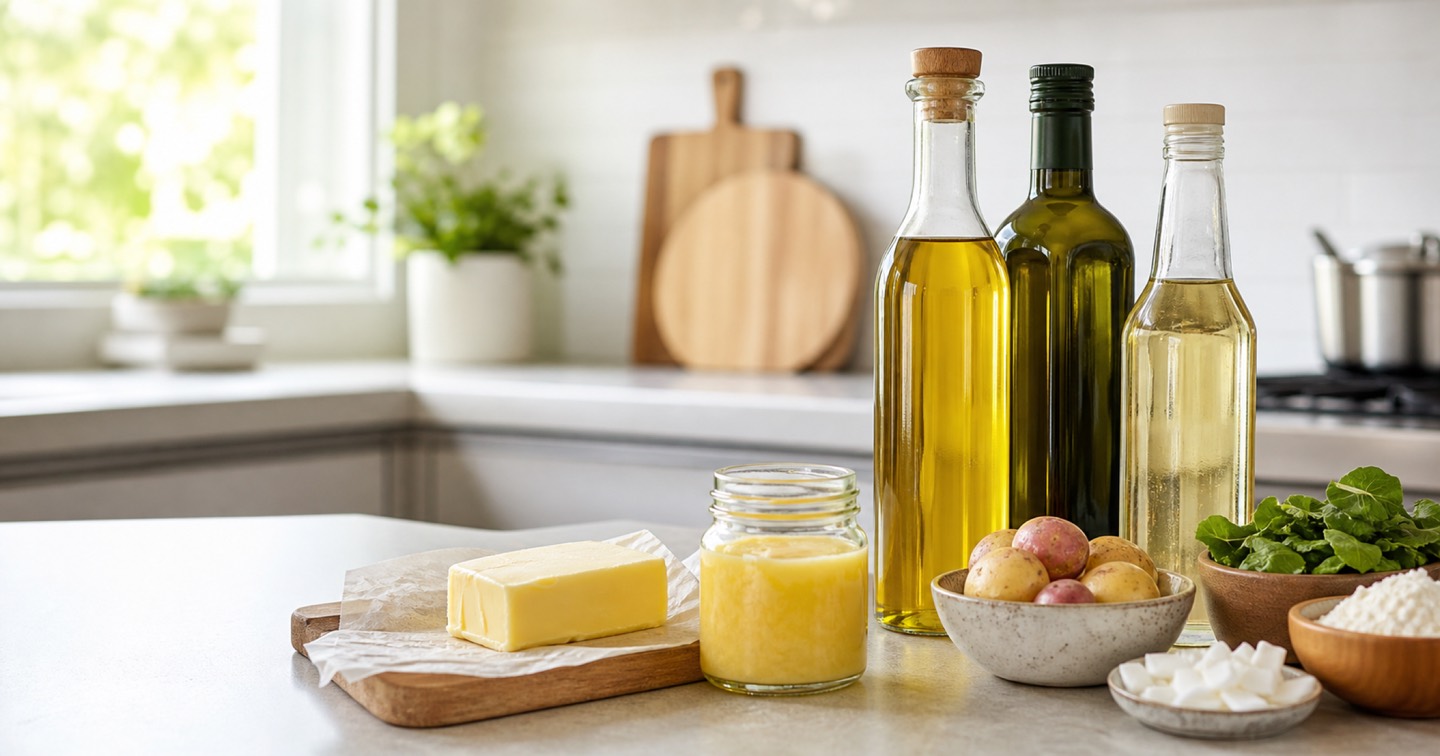
The best pantry fat is not one bottle that does everything. A better shelf has roles: a neutral high-heat oil, a flavor-forward olive oil, a dairy-fat option for browning and butter flavor, a neutral baking or frying backup, and a package you can finish before light, heat, oxygen, and time make the label less useful than it looked online. This Fridgeful ranking asks which exact products make those roles easiest to verify from public evidence.
This is not a health claim, not a medical recommendation, not a smoke-point test, not a frying-performance test, and not a promise that one fat is nutritionally superior. It scores label usefulness. USDA Organic handling rules allow mechanical, biological, and physical processing methods and restrict certain synthetic solvents and aids for organic products under 7 CFR 205.270. That helps with organic oils, but it still does not publish a crop lot, extraction temperature, storage history, or lab result for your bottle. For dairy fats, U.S. law defines butter around milk or cream and at least 80 percent milk fat, but that definition does not make ordinary butter a high-heat substitute for refined oils or ghee.
How to build the shelf
Start with heat, but do not stop there. A smoke-point number is useful only when it is attached to an exact product and a realistic cooking job. A neutral refined avocado oil can handle searing or roasting without adding much flavor. An extra-virgin olive oil can be excellent for sauteing, roasting, baking, and finishing when the brand gives freshness, origin, and certification cues, but it is not neutral. Ghee gives dairy flavor with less water and milk solids than butter, so it is useful for browning, frying, and baking. Butter is the better flavor tool for toast, sauces, pastry, cookies, and finishing, even when it ranks lower for high-heat general use.
Ingredient and processing disclosure come next. The strongest pages name the oil or fat, extraction or clarification method, refinement state, package size, use cases, and exact retail identifiers. Avocado oil deserves extra skepticism because UC Davis' avocado-oil program has documented quality and purity concerns in the category. That does not automatically penalize every avocado oil. It raises the bar: recurring testing language, exact SKU data, country information, lot or best-by cues, and restrained claims matter.
Six exact products, read by use case
1. Chosen Foods Refined Avocado Oil, 25.4 fl oz - 88. This is the best high-heat neutral anchor in the set. Chosen's official 25.4-ounce page identifies avocado oil as the ingredient, describes natural refining, gives a 500 F smoke-point claim, and names sauteing, grilling, searing, roasting, frying, and baking uses. The page also says the company tests every batch for purity. Target's exact 25.4-ounce listing adds current in-stock evidence, avocado oil as the ingredient, Mexico origin, TCIN 53381591, UPC 853807005828, a glass-bottle Q&A, and an estimated smoke-point range. The limitation is still real: the public trail is not a lot-specific certificate, and smoke-point claims do not measure oxidation or storage condition.
2. California Olive Ranch 100% California Extra Virgin Olive Oil, 16.9 fl oz - 84. This is the best flavor-forward everyday oil, not the most neutral option. California Olive Ranch's 100% California page says the oil is cold pressed, sourced from California farms and grower partners, tested by internal and outside certifying bodies, and suited for roasting, grilling, sauteing, baking, and frying. It also shows California Grown, Applied Sensory, kosher, Non-GMO, and OOCC-member cues. Target's exact 16.9-ounce page supports the retail SKU path. The key caveat is flavor and freshness: an EVOO may be the right oil for vegetables, beans, eggs, dressings, and finishing, while a neutral recipe may still want avocado, canola, or sunflower oil.
3. 4th & Heart Original Ghee, 9 oz - 80. Ghee earns the dairy-fat heat role. The 4th & Heart Original Ghee page identifies clarified butter from milk, says it can be spread, melted, fried, and baked, and shows a 485 F smoke-point benefit. It also gives 9-ounce glass and larger plastic-jar packaging context, direct buying, shop-local paths, and the ingredient statement. That makes it practical for eggs, vegetables, skillet potatoes, rice, and baked goods when butter flavor is part of the point. It ranks behind the top two because it is milk-derived, narrower in flavor, and the public page does not expose farm-level feed verification, USDA Organic proof, lot lookup, or independent smoke-point testing.
4. Spectrum Organic Canola Oil, Refined, 32 fl oz - 76. Spectrum is the strongest organic neutral-oil baseline here. Its Organic Canola Oil, Refined page states "up to 450 F," all-purpose cooking, frying, and roasting uses, 16- and 32-ounce sizes, purchase paths through Amazon, Target, Kroger, Walmart, and iHerb, and the ingredient "expeller pressed refined organic canola oil." That is a useful amount of public processing language for a seed oil. The score is capped because the page does not name crop origin, farms, lot codes, refining steps, certifier certificate, or residue testing for the exact bottle.
5. La Tourangelle Organic High Oleic Sunflower Oil, 500 mL - 75. La Tourangelle gives a strong high-oleic sunflower option for shoppers who want neutral high-temperature cooking with organic and CCOF-style cues. The official product page identifies a 500 mL format, organic high-oleic sunflower oil from expeller-pressed GMO-free organic seeds, high cooking temperature, and saute, fry, and grill uses. It also shows organic, CCOF, kosher, non-GMO, and BPA-free icons. It loses exact-SKU and claim-discipline points because the public record is thinner on UPC, lot, crop origin, and retail identifiers, and skin-care or wellness-adjacent content is not cooking evidence.
6. Kerrygold Salted Butter, 1 lb - 64. Kerrygold ranks last only because this is a heat-use ranking. Its U.S. Salted Butter page gives useful identity evidence: salted butter, pasteurized cream, salt, a one-pound format, grass-fed Irish milk context, and cooking and baking examples. That makes it a strong butter-flavor choice for toast, sauces, browning, cookies, cakes, and finishing vegetables. It is not the right all-purpose high-heat oil. The page does not provide a smoke-point claim, organic proof, lot-level feed verification, or the water and milk-solid reduction that makes ghee more heat tolerant.
Fridgeful Signal Ranking
This is an editorial ranking of public heat-use and pantry-role evidence. It is not a health claim, not a safety finding, not a price ranking, not an endorsement of high-heat frying, and not a test of flavor, freshness, or oxidation.
Eligibility requires an exact current U.S.-market pantry fat with a stable official or retailer path. The 100-point rubric is: cooking-temperature and use-case fit 25; ingredient, extraction, refining, or clarification disclosure 20; exact SKU, size, ingredient, and identifier evidence 15; certification, testing, origin, or traceability evidence 15; household versatility and format fit 15; and claim discipline 10. Criteria scores below follow that order.
| Rank | Exact product | Score | Criteria scores | Best evidence-led use |
|---|---|---|---|---|
| 1 | Chosen Foods Refined Avocado Oil, 25.4 fl oz | 88 | 25/17/15/14/10/7 | Neutral high-heat anchor. |
| 2 | California Olive Ranch 100% California EVOO, 16.9 fl oz | 84 | 18/17/15/14/15/5 | Flavor-forward everyday cooking and finishing. |
| 3 | 4th & Heart Original Ghee, 9 oz | 80 | 23/17/13/10/10/7 | High-heat dairy fat with butter flavor. |
| 4 | Spectrum Organic Canola Oil, Refined, 32 fl oz | 76 | 21/17/13/8/12/5 | Organic neutral frying, roasting, and baking baseline. |
| 5 | La Tourangelle Organic High Oleic Sunflower Oil, 500 mL | 75 | 21/18/12/9/12/3 | Organic high-oleic sunflower cooking option. |
| 6 | Kerrygold Salted Butter, 1 lb | 64 | 9/13/14/12/10/6 | Classic butter role for baking, sauces, toast, and finishing. |
What to buy first
For a small pantry, buy one neutral high-heat oil and one flavor-forward oil before adding specialty fats. A practical two-bottle setup is avocado oil for searing or roasting and EVOO for vegetables, dressings, beans, eggs, and finishing. Add ghee only if your cooking often wants butter flavor over higher heat. Add butter when baking, browning, sauces, and table use matter. Add canola or sunflower when a recipe needs neutral oil in volume and you want a lower-cost backup with enough public label evidence.
At the shelf, photograph the front, back, ingredient statement, allergen panel, organic or non-GMO marks, UPC, lot, best-by date, country line, and receipt. Then store oils closed, cool, and away from the stove; keep butter cold; and use open bottles quickly enough that package protection still matters. Fridgeful's durable record is the exact product trail, not the idea that one fat can do every job.
Sources
- 7 CFR 205.270, Organic handling requirements. Electronic Code of Federal Regulations. Accessed 2026-08-01.
- 21 U.S. Code 321a, Butter defined. Legal Information Institute / Cornell Law School. Accessed 2026-08-01.
- Avocado Oil. UC Food Quality / UC Davis. Accessed 2026-08-01.
- Refined Avocado Oil 25.4 Fl Oz. Chosen Foods. Accessed 2026-08-01.
- Chosen Foods 100% Pure Avocado Oil, 25.4 fl oz. Target. Accessed 2026-08-01.
- 100% California. California Olive Ranch. Accessed 2026-08-01.
- California Olive Ranch 100% CA Extra Virgin Olive Oil, 16.9 fl oz. Target. Accessed 2026-08-01.
- 4th & Heart Original Ghee. 4th & Heart. Accessed 2026-08-01.
- Organic Canola Oil, Refined. Spectrum. Accessed 2026-08-01.
- Organic High Oleic Sunflower Oil. La Tourangelle. Accessed 2026-08-01.
- Salted Butter. Kerrygold USA. Accessed 2026-08-01.
- What is the smoke point of 100% Pure Avocado Oil?. Chosen Foods Help Center. Accessed 2026-08-01.