Organic butter and grass-fed butter
Organic and grass-fed butter labels answer different questions, so the strongest shelf signal is a product that ties the exact pack to audited organic rules, a clear dairy diet claim, and current retail evidence.
- Published
- Category
- Oils and fats
- Sources
- 17 cited
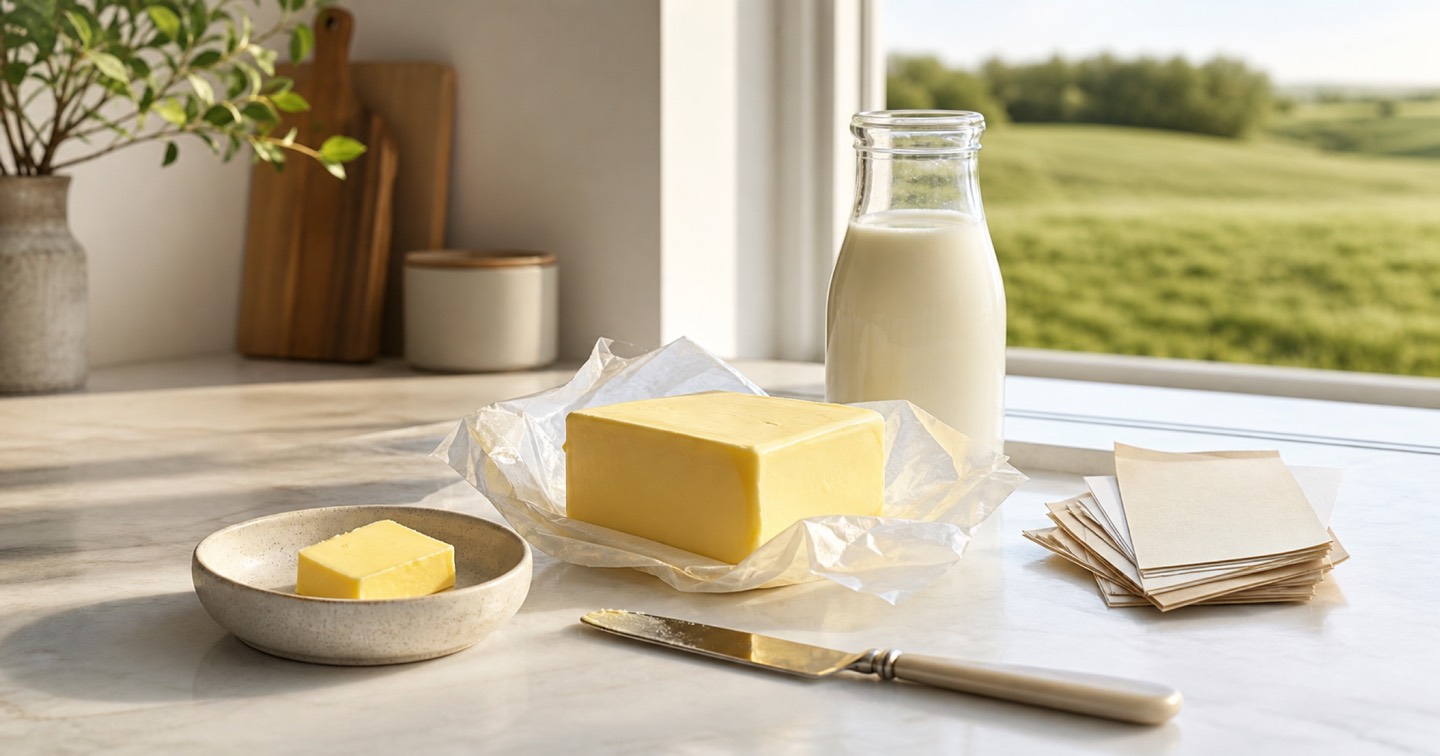
Butter labels mix several claims that sound similar but do different jobs. "Organic" is a regulated production system. "Grass-fed" is a diet claim. "Pasture-raised" describes outdoor access or grazing, but the public meaning depends on the standard behind it. "Irish," "European-style," "Grade AA," and "higher butterfat" can describe origin, format, or texture without proving organic or grass-fed status.
Start with the product itself. U.S. law defines butter as made from milk or cream, with or without salt or coloring, and at least 80 percent milk fat. USDA Organic adds a different layer. Under 7 CFR 205.237, organic ruminants must receive organic feed, must not be fed antibiotics or hormones for growth, and must graze through a regional grazing season of at least 120 days while averaging at least 30 percent dry matter intake from pasture during that season. USDA's organic livestock and dairy overview also emphasizes organic plans, records, and annual inspection.
That still does not make every organic butter 100% grass-fed. Organic Plus Trust's certification standards make the distinction directly: organic alone does not guarantee grass-fed or pasture-raised, and ordinary grass-fed language does not automatically mean grain-free, third-party certified, or pasture-managed. This ranking therefore gives the most credit to exact butter products that combine organic evidence, a specific grass or pasture standard, exact SKU documentation, and current retail availability. It does not reward taste, color, omega-3, CLA, ethical, environmental, or "best butter" copy as proof.
What counts as stronger butter evidence
The strongest shopper-facing evidence is product-specific. An exact official page should name the butter, size, ingredient list, and claim. A retailer page should add current availability and identifiers such as UPC, TCIN, DPCI, or a stable grocery product path. A certification page should explain whether the claim covers this product, this brand, this farm system, or merely a broader category.
A 100% grass-fed organic system earns more diet credit than a pasture-raised claim that allows grain. That does not make the butter healthier, safer, better-tasting, or more humane in this article's scoring. It only means the public label trail answers the grass-diet question more directly. Certified Grassfed by A Greener World is one example of a stricter grass-fed program; its FAQ says the claim is an add-on to Animal Welfare Approved and covers ruminants on a grass and forage diet. Organic Plus Trust is the more relevant public source for the certified organic dairy brands reviewed here, because its certified-brands page names Maple Hill and describes the certification frame for grass-fed organic dairy.
1. Maple Hill Creamery Organic Salted Butter, 8 oz - 90. Maple Hill has the cleanest combined organic and grass-fed story. Its grass-fed butter page identifies salted butter made with organic cream and sea salt and says the butter is made with 100% grass-fed dairy. Whole Foods' exact 8-ounce page confirms a current retail path and ingredient statement. Organic Plus Trust lists Maple Hill as a certified grass-fed organic dairy brand. The limitation is package-level visibility: the public pages do not show the farm, processor, UPC, lot, or exact certifier certificate for the box a shopper buys.
2. Organic Valley Salted Organic Butter, 8 oz - 82. Organic Valley is the strongest broad organic baseline in this group. Its official organic salted butter page lists 8-ounce and one-pound sizes, UPCs, ingredients, USDA Organic, kosher, halal, and pasture-raised cues. Target's exact 8-ounce listing adds a current price path and says the cream comes from pasture-raised cows. This is useful, current evidence. The caveat is also important: Fridgeful did not treat this butter as Organic Valley Grassmilk or as 100% grass-fed, because the exact butter page does not make that claim.
3. Kerrygold Irish Grass-fed Salted Butter Sticks, 16 oz - 76. Kerrygold gives shoppers a clear grass-fed and origin signal. Its salted sticks page describes the 16-ounce stick format, Irish milk, pasteurized cream, and salt. Target's exact listing supplies current availability, country of origin, TCIN 92077080, UPC 767707014302, and Ireland import status. Kerrygold loses organic and certification points because the public trail does not attach USDA Organic, Organic Plus Trust, or a lot-level feed audit to this exact pack. "Grass-fed" is meaningful context here, not a complete verified farm map.
4. Vital Farms Pasture-Raised Salted Butter, 8 oz - 73. Vital Farms is unusually specific about the feed split, which helps shoppers avoid guessing. Its butter page says the cows are 90% grass-fed and have warm-month outdoor access averaging 200 days a year. Its FAQ clarifies that the remaining 10% includes grain, vitamins, and minerals. Target's exact 8-ounce salted page confirms two 4-ounce sticks, current in-stock status, the pasture-raised claim, and a current retail path. This is not ranked higher because it is not organic, not 100% grass-fed, and not tied to a third-party grass-fed certification in the accessible record.
5. 365 by Whole Foods Market Organic Butter Salted, 1 lb - 66. The 365 product is a useful private-label organic baseline. Whole Foods' exact one-pound page identifies Grade AA organic salted butter, organic sweet cream, salt, a cart path, and a seasonal color caveat. That is a disciplined presentation because it does not overreach into grass-fed claims. The tradeoff is thin sourcing: no public dairy supplier, certifier, pasture standard, origin bridge, or lot trail is visible.
6. Good & Gather Organic Salted Butter, 1 lb - 64. Good & Gather has the strongest exact retailer identity among the lower-scoring organic options. Target's product page identifies USDA Organic, Non-GMO, kosher, organic Grade A pasteurized sweet cream, salt, TCIN 54575962, UPC 085239043356, DPCI 284-12-0042, and current in-stock status. Those details make the exact pack easy to recognize. They do not answer the grass-fed question. The page does not name the dairy supplier, certifier, farm system, origin, pasture protocol, or package-level traceability.
Fridgeful Signal Ranking
This is an editorial ranking of public butter label evidence. It is not a health claim, not a safety finding, not a taste test, not a price ranking, not an animal-welfare outcome audit, and not proof that a specific refrigerated pack is fresher or better than another one.
Eligibility requires an exact current U.S.-market dairy butter product with a stable official or retailer path. The 100-point rubric is: verified organic, grass-fed, or pasture claim evidence 25; grass diet and pasture specificity 25; exact SKU, size, ingredient, and identifier evidence 15; supply-chain, certifier, origin, or farm-system visibility 15; current U.S. availability evidence 10; and claim discipline 10. Criteria scores below follow that order.
| Rank | Exact product | Score | Criteria scores | Best evidence-led read |
|---|---|---|---|---|
| 1 | Maple Hill Organic Salted Butter, 8 oz | 90 | 24/24/13/12/8/9 | Best combined organic and 100% grass-fed public trail. |
| 2 | Organic Valley Salted Organic Butter, 8 oz | 82 | 23/14/15/11/10/9 | Strong organic/pasture baseline, not a 100% grass-fed butter. |
| 3 | Kerrygold Irish Grass-fed Salted Butter Sticks, 16 oz | 76 | 14/19/15/12/10/6 | Clear grass-fed Irish identity, weaker certification proof. |
| 4 | Vital Farms Pasture-Raised Salted Butter, 8 oz | 73 | 13/18/13/12/8/9 | Specific 90% grass and 200-day pasture claim. |
| 5 | 365 Organic Butter Salted, 1 lb | 66 | 19/7/13/8/9/10 | Organic private-label baseline with restrained claims. |
| 6 | Good & Gather Organic Salted Butter, 1 lb | 64 | 18/6/15/6/10/9 | Excellent exact identity, little public supplier or pasture evidence. |
What to check before buying
At the shelf, separate the questions. If you want certified organic, look for the USDA Organic seal and certifier statement on the actual package. If you want 100% grass-fed, look for those words and a credible third-party standard rather than assuming "pasture-raised" means grain-free. If you want a cooking format, compare salted versus unsalted, block versus sticks, butterfat, price per ounce, and how quickly your household will use the package after opening.
Keep the package record. Photograph the front, back, ingredient panel, certifier line, UPC, lot, date code, country of origin, and store receipt. If a brand or retailer page changes later, those package details become the durable evidence for the butter actually in your fridge. Fridgeful's ranking can narrow the label audit, but the final check is always the exact box in hand.
Sources
- 7 CFR 205.237, Livestock feed. Electronic Code of Federal Regulations. Accessed 2026-07-28.
- Organic Livestock and Dairy. USDA Agricultural Marketing Service. Accessed 2026-07-28.
- 21 U.S. Code 321a, Butter defined. Legal Information Institute / Cornell Law School. Accessed 2026-07-28.
- Certification Standards. Organic Plus Trust. Accessed 2026-07-28.
- Certified Brands. Organic Plus Trust. Accessed 2026-07-28.
- Grass-Fed Butter. Maple Hill Creamery. Accessed 2026-07-28.
- Organic Salted Butter, 8 Ounce. Whole Foods Market. Accessed 2026-07-28.
- Organic Salted Butter. Organic Valley. Accessed 2026-07-28.
- Organic Valley Salted Organic Butter, 8 oz. Target. Accessed 2026-07-28.
- Kerrygold Salted Butter Sticks 1LB. Kerrygold USA. Accessed 2026-07-28.
- Kerrygold Irish Grass-fed Salted Butter Sticks, 16 oz. Target. Accessed 2026-07-28.
- Butter. Vital Farms. Accessed 2026-07-28.
- Pasture Raised Eggs FAQ: Organic, Certified Humane. Vital Farms. Accessed 2026-07-28.
- Vital Farms Pasture-Raised Salted Butter, 8 oz. Target. Accessed 2026-07-28.
- Organic Butter Salted, 1 lb. Whole Foods Market. Accessed 2026-07-28.
- Organic Salted Butter, 1 lb, Good & Gather. Target. Accessed 2026-07-28.
- Grassfed FAQ. A Greener World. Accessed 2026-07-28.