Best produce choices for low-waste shopping
Whole, canned, frozen, snack-pack, baby-cut, and matchstick carrots solve different planning problems; the best low-waste choice is the format your household can actually finish.
- Published
- Category
- Produce
- Sources
- 13 cited
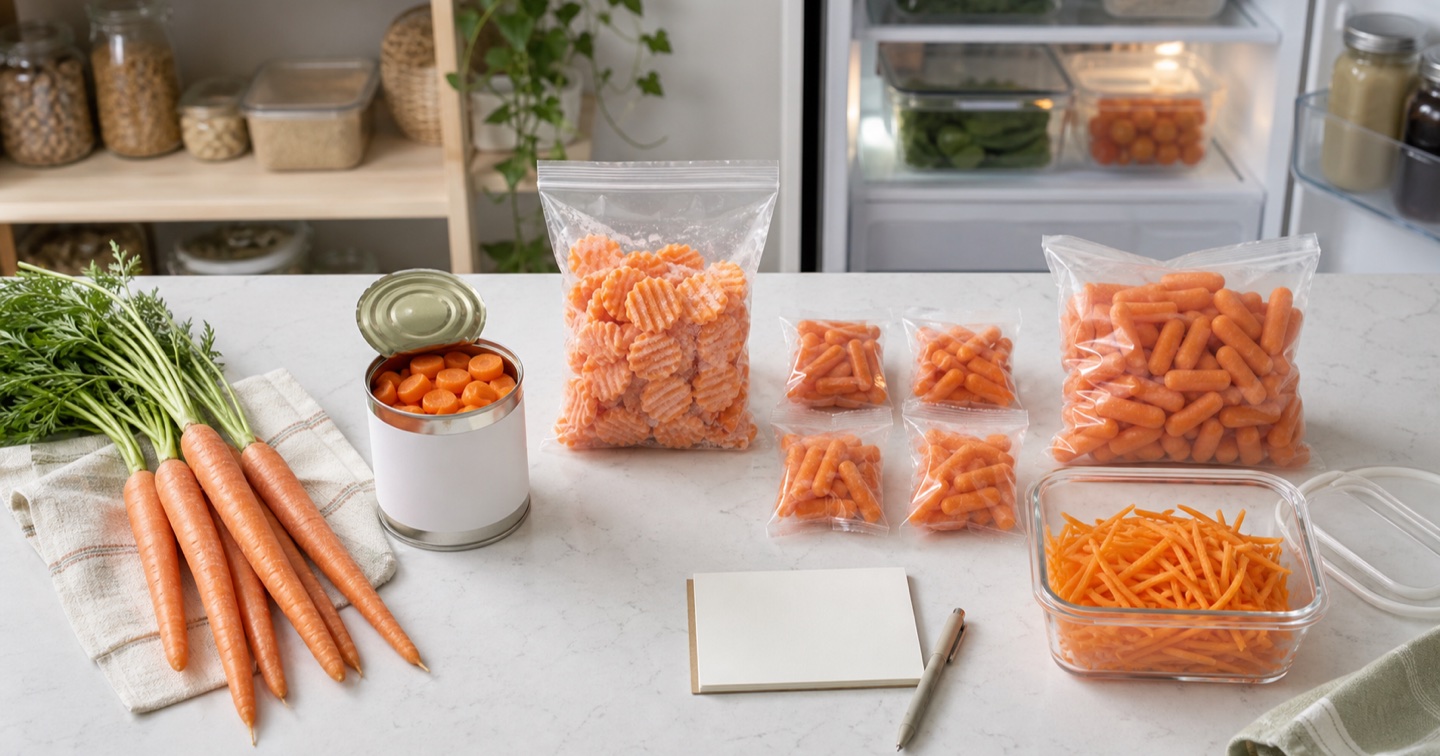
“Buy fresh” is not a complete low-waste strategy. A whole vegetable can be a flexible ingredient, a frozen bag can wait for a later meal, a can can sit unopened in the pantry, and a divided snack pack can protect unopened portions. The best choice depends on the meals, storage space, and attention a household can realistically give the food after checkout.
This comparison holds the ingredient and brand mostly constant: six current Good & Gather carrot formats. That makes package size, preparation, and public handling guidance easier to see. It does not turn one retailer’s assortment into a universal answer. The ranking estimates planning resilience—how many documented paths a shopper has to store, portion, and use a product—not measured waste in real homes.
That boundary matters. EPA says that planning, checking existing supplies, buying quantities tied to expected meals, storing produce properly, and freezing surplus can help households prevent wasted food. Its broader source-reduction guidance puts prevention ahead of managing food after it becomes waste. Those principles support comparing formats, but they do not prove that any item here is thrown away more or less often.
How the ranking works
The fixed 100-point rubric assigns 20 points each to portion match, verified storage guidance, and use-up flexibility; 15 to prep and edible clarity; 10 each to package handling and exact identity; and 5 to claim discipline. Current Target availability was captured as a July 27 snapshot but left out as a differentiator because local inventory can change quickly.
Package handling has a narrow meaning here. It rewards independently protected portions, clear opening or cooking instructions, and a documented reseal feature when one exists. It does not compare plastic weight, manufacturing, transport, recycling, compostability, or full lifecycle impact. A high package score is not a sustainability verdict.
No score assumes how much a shopper trims from whole carrots, the drained weight of canned carrots, or the edible yield of any format. Serving counts are label information, not proof that a household will use that amount. USDA Organic applies to the whole-carrot entry, but organic certification is not evidence that the product prevents waste. This is also not a health claim, a nutrition ranking, a safety test, or a price comparison.
For fresh handling, FDA advises shoppers to choose pre-cut packaged produce that is refrigerated and to refrigerate all purchased pre-cut or packaged produce. FDA also explains that prewashed, ready-to-eat labeling controls whether another wash is needed. Those are safety directions, not universal shelf-life promises. For quality-oriented storage lookups, the federal FoodKeeper is a useful companion to the package.
1. Whole organic carrots — 88/100
The one-pound whole organic carrots take first place because one format can become sticks, coins, shreds, roasted sides, soup, or juice. Target identifies them as raw and ready to eat but says to wash before eating. That earns less prep clarity than the peeled options while preserving the widest use-up flexibility.
The storage case is also unusually concrete. EPA’s household food-waste guidance places carrots among vegetables suited to a refrigerator’s high-humidity drawer. Utah State University Extension says carrots can keep for a few weeks in a perforated bag in the crisper and advises separating them from ethylene-producing fruit. That is useful general guidance, not a guarantee for this bag. Condition, refrigerator performance, and the physical label still control.
Score: 19 + 17 + 20 + 12 + 6 + 10 + 4 = 88.
2. Canned sliced carrots — 87/100
The 14.5-ounce canned sliced carrots are fully cooked, heat-and-serve pieces that can go into soups, stews, salads, or a side dish. Their unopened pantry format earns the strongest storage score, while the single can offers less portion control than separate packs. We did not infer a drained weight or compare drained carrots with a pound of whole carrots.
Opening the can starts a different plan. Target directs shoppers to refrigerate the remainder in a separate covered glass or plastic container. USDA’s shelf-stable food chart lists carrots among low-acid canned goods and gives them three to four days refrigerated after opening. That specific window supports the score; it does not override a package warning, damaged-can concern, or other safety signal.
Score: 12 + 20 + 18 + 15 + 9 + 10 + 3 = 87.
3. Frozen crinkle-cut carrots — 84/100
The 12-ounce frozen crinkle-cut carrots arrive blanched and cut in a microwaveable steamer bag, with both microwave and stovetop directions. Target says to keep them frozen, cook them fully to 165°F, and refrigerate or discard leftovers immediately. Those exact instructions earn high storage and prep scores.
The bag is treated as a one-shot package in this comparison. The page tells shoppers to microwave it unopened and never advertises a resealable closure. It might be physically possible to open and transfer a portion while frozen, but the public evidence does not establish that workflow. Claim discipline means scoring what is documented rather than turning possibility into a feature.
Score: 12 + 19 + 14 + 15 + 9 + 10 + 5 = 84.
4. Four carrot snack packs — 83/100
The four-count snack pack contains four independent three-ounce bags. That is the clearest portion structure in the field: one opened serving leaves three units protected. Target identifies the carrots as peeled, prewashed, raw, and ready to eat, so prep and edible-state language is equally clear.
The format loses flexibility because its public use case centers on snacking, and the evidence does not supply a universal storage duration. FDA’s refrigeration direction applies, while the physical package date and instructions must decide the usable window. The four bags earn handling credit only; the score does not claim that more individual packaging has a better environmental lifecycle.
Score: 20 + 15 + 9 + 15 + 10 + 10 + 4 = 83.
5. Petite baby-cut carrots — 81/100
The 12-ounce petite baby-cut carrots are peeled, prewashed, raw, and ready to eat. Target suggests them for snacks and cooked dishes, creating several use-up paths without requiring the shopper to cut a whole carrot first. No bonus is given for an assumed trim or edible-yield advantage.
Because these are fresh-cut packaged carrots, refrigeration is the verified baseline. Neither the general FDA guidance nor the retailer page provides a universal after-opening shelf life for this exact bag. The package date, condition, refrigerator temperature, and any current product-specific directions matter more than a generic internet estimate.
Score: 16 + 12 + 17 + 15 + 7 + 10 + 4 = 81.
6. Matchstick carrots — 80/100
The 10-ounce matchstick carrots are also peeled, prewashed, raw, and ready to eat. The cut works across salads, stir-fries, and baking, so the entry nearly matches the whole carrots on use-up flexibility. Its smaller weight can fit some plans, but the bag is not divided into protected portions.
The last-place finish is narrow and evidence-driven. Target does not publish a universal shelf life or reseal claim, and this analysis does not convert a thin cut into an asserted spoilage rate. That restraint lowers verified-storage points while preserving strong prep and use scores.
Score: 16 + 10 + 18 + 15 + 7 + 10 + 4 = 80.
Fridgeful Signal Ranking
| Rank | Good & Gather format | Score | Criterion vector | Best planning fit |
|---|---|---|---|---|
| 1 | Whole organic, 1 lb | 88 | 19/17/20/12/6/10/4 | A household that will use carrots across several meals and prep styles. |
| 2 | Canned sliced, 14.5 oz | 87 | 12/20/18/15/9/10/3 | A pantry plan with a specific use for any remainder within three to four days after opening. |
| 3 | Frozen crinkle-cut, 12 oz | 84 | 12/19/14/15/9/10/5 | A planned cooked side or recipe that can use the one-shot bag. |
| 4 | Four snack packs, 3 oz each | 83 | 20/15/9/15/10/10/4 | Individually protected grab-and-go portions. |
| 5 | Petite baby-cut, 12 oz | 81 | 16/12/17/15/7/10/4 | Ready-to-eat snacking with a backup cooked use. |
| 6 | Matchstick, 10 oz | 80 | 16/10/18/15/7/10/4 | Salads, stir-fries, or baking already on the meal plan. |
The best choice is the one tied to a use
Before shopping, count the meals that can realistically use carrots and inspect what is already in the refrigerator, freezer, and pantry. Choose whole carrots when multiple recipes can absorb the bag and you will do the prep. Choose the can when pantry resilience matters and you have a plan for the opened remainder. Choose frozen when the whole package fits a cooked meal. Choose the snack packs when independent portions solve the actual problem.
Then follow the format-specific safety path. Refrigerate fresh and fresh-cut carrots as directed; keep the frozen product frozen and follow its cooking instructions; inspect cans and follow package warnings; and refrigerate opened canned leftovers for no more than the cited three-to-four-day window. Food safety is separate from low-waste planning: food that is unsafe is not rescued by a high score.
Finally, treat this ranking as a planning prompt, not a universal hierarchy. All six products came from one brand, availability was a temporary unscored snapshot, and no household discard was observed. The strongest low-waste choice is the package whose documented storage and use paths match what your household will actually do.
Sources
- Fresh Organic Carrots, 1 lb, Good & Gather. Target. Accessed 2026-07-27.
- Sliced Carrots, 14.5 oz, Good & Gather. Target. Accessed 2026-07-27.
- Frozen Crinkle-Cut Carrots, 12 oz, Good & Gather. Target. Accessed 2026-07-27.
- Fresh Baby-Cut Carrot Snack Pack, 3 oz/4 ct, Good & Gather. Target. Accessed 2026-07-27.
- Fresh Petite Baby-Cut Carrots, 12 oz, Good & Gather. Target. Accessed 2026-07-27.
- Fresh Matchstick Carrots, 10 oz, Good & Gather. Target. Accessed 2026-07-27.
- Preventing Wasted Food at Home. U.S. Environmental Protection Agency. Accessed 2026-07-27.
- Prevent Wasted Food Through Source Reduction. U.S. Environmental Protection Agency. Accessed 2026-07-27.
- Selecting and Serving Produce Safely. U.S. Food and Drug Administration. Accessed 2026-07-27.
- Raw Produce: Selecting and Serving It Safely. U.S. Food and Drug Administration. Accessed 2026-07-27.
- FoodKeeper App. FoodSafety.gov. Accessed 2026-07-27.
- Shelf-Stable Food Safety. USDA Food Safety and Inspection Service. Accessed 2026-07-27.
- Fruit and Vegetable Guide Series: Carrots. Utah State University Extension. Accessed 2026-07-27.