Flour sourcing and organic claims
Organic certification answers one important question. The strongest flour evidence also identifies the wheat, where it grew, how it was milled, and who certified the claim.
- Published
- Category
- Grains and bread
- Sources
- 13 cited
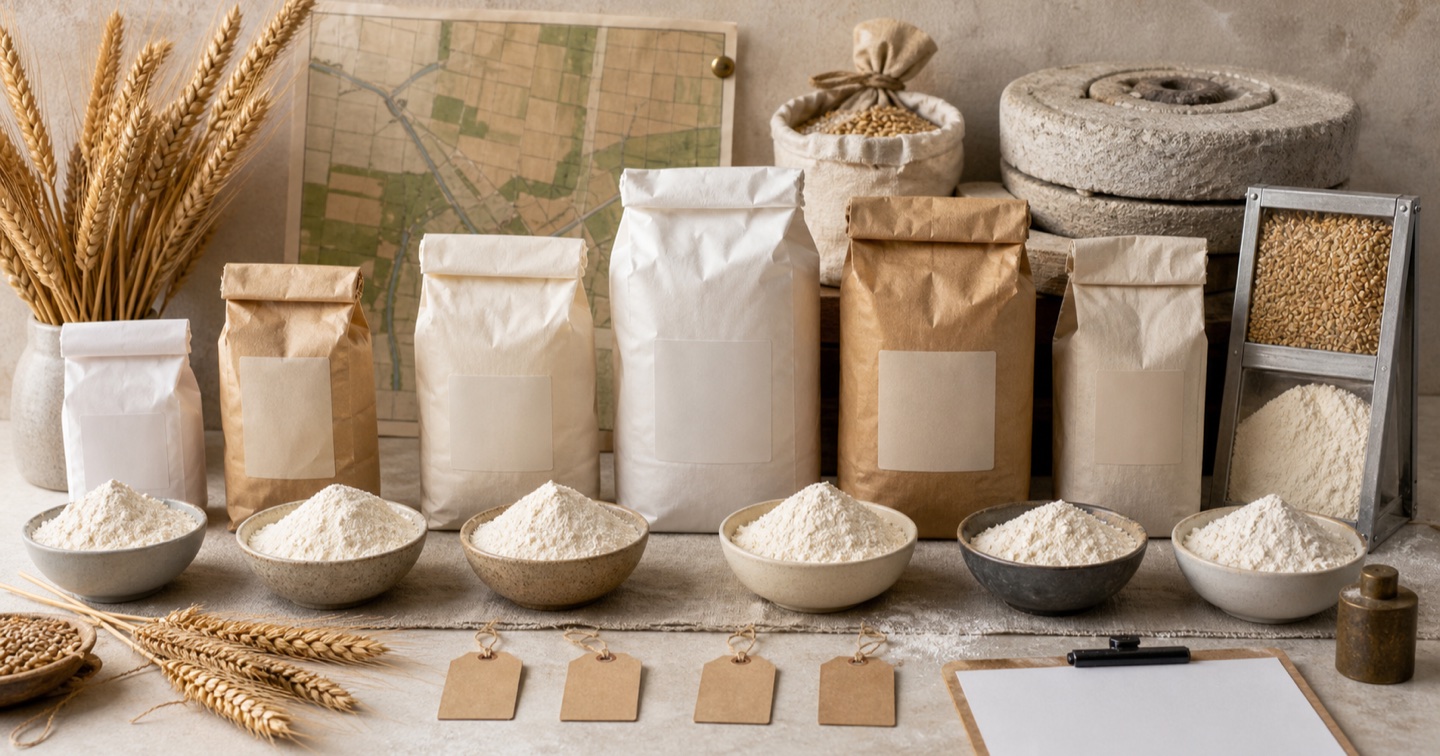
Organic on a flour bag is meaningful, but it does not tell the whole sourcing story. USDA says an organic label is reviewed by an accredited certifier and that products labeled “organic” must contain at least 95% organic ingredients, excluding salt and water. That is a production-and-handling standard. It does not, by itself, identify the wheat variety, farm, crop year, milling system or extraction rate.
This comparison asks a narrower shopping question: how much verifiable, product-specific sourcing evidence can a shopper find before buying? We reviewed exact manufacturer or retailer pages, current package records where available, and official certification explanations. A statement earned credit only when it could be tied to the precise flour being ranked or to a clearly identified company-wide certification program.
The category also needs a common baseline. Federal identity rules describe flour as cleaned wheat that has been ground and bolted, with specified optional ingredients and labeling requirements. “All-purpose” therefore should not be mistaken for a geographic claim or a promise about a particular mill. Read the current ingredient statement and package as the controlling record.
Fridgeful Signal Ranking
This is a ranking of public sourcing and claim evidence. It is not a health claim, a taste test, a nutrition ranking, a laboratory analysis or a guarantee of local stock. A lower score means the public evidence answered fewer of this rubric’s questions; it does not establish that the flour itself is worse.
1. Janie’s Mill Organic All-Purpose Flour — 94/100
Janie’s supplies the most complete field-to-flour account in this set. The exact product page names Warthog hard red winter wheat, says Janie’s Farm grows it “just down the road,” identifies stone-milling followed by sifting, and publishes an 80% extraction rate along with protein, ash and moisture figures. Those details make “stone-milled” inspectable rather than decorative.
The company FAQ says all grain entering the mill is USDA certified organic and names OCIA as the mill’s organic processor certifier. That is strong organizational traceability, though the reviewed pages do not provide a shopper-facing lot or harvest lookup. Direct ordering was visible, but small-mill inventory can be episodic.
2. Central Milling Organic All-Purpose Flour / Organic Beehive — 92/100
Central Milling’s exact Organic Beehive record identifies low-protein organic hard red winter wheat, organic malted barley flour, 10.5% protein and 0.55% ash. It also names the Utah Department of Agriculture and Food as the organic certifier and discloses OU kosher, non-GMO, AIB and SQF signals without treating them as interchangeable.
Its retail-product explanation adds the decisive origin detail: the wheat blend is grown near Central Milling’s Northern Utah mills. That is less specific than a named farm, field or harvest, but more useful than a country-only statement. Bag-size ordering options make availability unusually visible for a technically documented flour.
3. King Arthur Organic All-Purpose Flour — 81/100
King Arthur pairs an active exact storefront record with a downloadable package PDF. The package identifies certified organic unbleached hard red wheat flour plus enzyme, says the wheat is grown and milled in the United States, names Quality Assurance International as certifier, and supplies a stable item identity.
That is strong package discipline. The tradeoff is granularity: “United States” does not identify a state, mill, farm, wheat program or crop year, and the reviewed evidence does not explain the milling system or extraction as precisely as the first two entries. The flour still earns full exact-identity and availability credit.
4. Sunrise Flour Mill Heritage White Flour — 78/100
Sunrise’s Heritage White Flour page names organic Turkey Red heritage wheat and describes the flour as minimally processed, packed in small batches, freshly milled and naturally unbleached. It also explains that the white color comes from the wheat endosperm rather than bleaching. Those details give shoppers substantially more to verify than a generic organic claim.
However, the exact page does not identify the wheat farm, region or organic certifier with the clarity of the leaders. More importantly, it promotes digestibility for some people with gluten intolerance. This comparison records that as company marketing, not established medical evidence, and does not recommend this or any wheat flour for celiac disease or gluten-related symptoms. That restraint accounts for the lower claim-discipline score.
5. Bob’s Red Mill Organic Unbleached White All-Purpose Flour — 72/100
The exact Bob’s Red Mill product page identifies organic hard red wheat, provides a nutrition panel and describes the flour as unbleached, unenriched and free of potassium bromate. Its separate certification page states that Quality Assurance International has third-party certified the company’s organic products under the USDA National Organic Program since 2002.
The missing dimension is wheat origin. The reviewed public record does not narrow this exact flour to a growing region, named farm, crop year or lot, and “expertly milled” is not a process specification. The score therefore recognizes a solid exact label and named certifier without inferring provenance that the page does not provide.
6. Good & Gather Organic All-Purpose Flour — 55/100
Target’s exact five-pound listing clearly identifies Good & Gather Organic All-Purpose Flour, says it is unbleached and USDA Organic, and names Oregon Tilth as certifier. The retailer record also includes raw-flour handling language and location-sensitive ordering information. That is enough for exact identity, certification and availability.
It is not enough for origin or milling transparency. The public page reviewed does not identify a wheat variety, farm, region, mill, extraction or milling system. Good & Gather’s last-place position is therefore an evidence gap, not a negative product test.
How to read the claims on any flour bag
Start with the certifier. USDA’s organic-labeling guide explains that organic labels are approved by USDA-accredited certifying agents and distinguishes “100 percent organic,” “organic” and “made with organic” language. A named certifier helps connect the seal to an accountable certification system, but it still does not prove a flour’s geographic origin.
Then separate ingredient disclosure from milling disclosure. The current federal flour standard allows specified ingredients and requires their declaration. “Unbleached,” “unenriched,” “stone-milled,” protein percentage and extraction rate answer different questions. Check each rather than compressing them into a single idea of quality.
For origin, prefer a ladder of specificity: named farm and wheat variety; named region and mill; country; or no origin. A company story can be helpful, but it should not be silently applied to every product. Lot, crop-year or harvest documentation would be stronger still, and none of the reviewed consumer pages offered a complete public lookup.
Finally, handle every flour as raw. FDA’s raw-flour guidance says most flour has not been treated to kill bacteria and advises against eating or tasting raw flour, dough or batter. Organic status, heritage grain, bleaching language and milling method do not change that food-safety rule.
Bottom line
Janie’s Mill and Central Milling lead because they make the sourcing chain concrete: wheat identity, place and milling detail appear on records tied to the ranked products. King Arthur, Bob’s Red Mill and Good & Gather offer useful certification or label records but progressively less geographic and milling specificity. Sunrise provides unusually rich grain and processing language, while its health-adjacent digestibility marketing requires extra caution.
Use this ranking as a map for asking better questions, then recheck the bag you are actually buying. Formulas, suppliers, packages, certifiers, prices and availability can change after the access date.
Sources
- Labeling Organic Products. USDA Agricultural Marketing Service. Accessed 2026-07-27.
- 21 CFR 137.105 — Flour. Electronic Code of Federal Regulations. Accessed 2026-07-27.
- Flour Is a Raw Food and Other Safety Facts. U.S. Food and Drug Administration. Accessed 2026-07-27.
- Organic All Purpose Flour. Janie’s Mill. Accessed 2026-07-27.
- Frequently Asked Questions. Janie’s Mill. Accessed 2026-07-27.
- Organic All-Purpose Flour / Organic Beehive. Central Milling. Accessed 2026-07-27.
- Retail Products. Central Milling. Accessed 2026-07-27.
- Organic All-Purpose Flour. King Arthur Baking Company. Accessed 2026-07-27.
- Organic All-Purpose Flour package record, item 308006. King Arthur Baking Company. Accessed 2026-07-27.
- Heritage White Flour. Sunrise Flour Mill. Accessed 2026-07-27.
- Organic Unbleached White All-Purpose Flour. Bob’s Red Mill. Accessed 2026-07-27.
- Food Safety and Certifications. Bob’s Red Mill. Accessed 2026-07-27.
- Organic Flour — 5LB — Good & Gather. Target. Accessed 2026-07-27.