Regenerative beef claims and verification
ButcherBox's exact ROC 93/7 has the strongest current public claim trail. Among 85/15 products, Thousand Hills narrowly leads Verde, while Force of Nature leaves more source scope unresolved.
- Published
- Category
- Beef
- Sources
- 27 cited
The short version
“Regenerative” is not one uniform beef standard. The useful question is narrower: can a shopper connect an exact package to a defined program, an independent verifier, measured land evidence, and a traceable source?
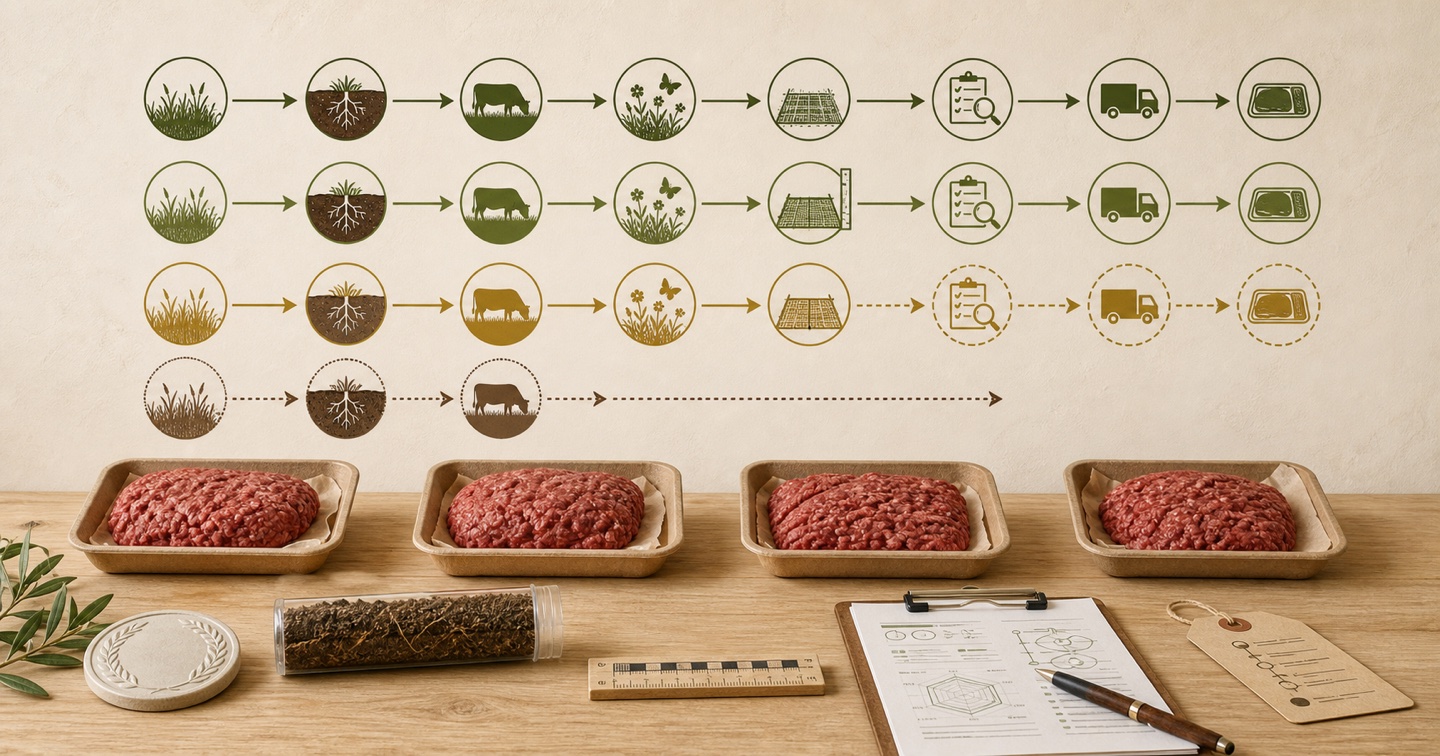
Fridgeful ranked four current ground-beef products on that public claim-verification trail. ButcherBox Regenerative Organic Certified Ground Beef 93/7 leads at 88 because its exact product appears in the Regenerative Organic Alliance directory. Thousand Hills Grass Fed Ground Beef 85/15 scores 79, one point ahead of Verde Farms 85% Lean Ground Beef at 78. Force of Nature Grass Fed Ground Beef 85/15 scores 52.
ButcherBox’s formulation is a correction: its current 85/15 is not presented as ROC; the certified exact item is 93/7. This is not a health claim, taste test, food-safety judgment, life-cycle assessment, or proof that one product causes better environmental outcomes.
What a regenerative claim can and cannot prove
USDA FSIS treats “Raised using Regenerative Agriculture Practices” as an environment-related label claim. Its current substantiation guideline says establishments should document the meaning of the claim, animal-raising controls, traceability and segregation; FSIS also encourages third-party certification.
The FTC Green Guides summary adds a consumer-protection lens: broad environmental-benefit claims are difficult to substantiate, qualifications should be clear and specific, and a third-party seal does not remove the marketer’s duty to support every express and implied claim.
This ranking does not award environmental superiority merely because a page says “regenerative,” “better for the planet,” or “carbon sink.” Practice rules, audits, land monitoring, outcome results, and package-to-ranch traceability are different signals.
Methodology and fixed bands
Eligible products are current U.S.-market, raw, single-ingredient ground beef with a stable official page and an explicit regenerative claim or exact certification mark. Lean ratio is not scored. A proposed formulation is corrected only when the verifier and brand expose a stable exact-product bridge. That is why ButcherBox 93/7 is ranked and the plain 85/15 is an unranked mismatch. Certifications are never transferred from a sibling SKU.
The fixed 100-point bands are:
- Exact product claim linkage, 20: 20 for an exact page or package plus an explicit regenerative claim and a named program bridge; 15 for an exact claim with only brand-level program scope; 8 for adjacent line evidence; zero when the exact item has no regenerative claim.
- Public program controls, 20: 20 for a current public standard plus recurring supplier, farm, load, or chain-of-custody controls; 15 for a named verifier method and supplier requirements; 10 for a detailed brand standard without public audit mechanics; 5 for generic practices; zero none.
- Independent verification, 25: 25 for a current verifier-hosted exact-product record; 20 for a verifier-hosted product-line or ranch-network bridge; 15 for current verifier membership plus a dated program bridge; 8 when independent certification covers only some possible supply; zero none.
- Measured outcome evidence, 15: 15 for current outcomes tied to the exact product’s named land; 12 for a measured-outcomes program and quantified land bases tied to the line; 8 for monitored or tested supply without public exact-land results; 5 for practices only; zero none.
- Product-to-land traceability, 10: 10 for a package or lot lookup to a ranch or land base; 7 for a finite verified supplier network; 5 for regions or a network without pack resolution; 2 for country only; zero none.
- Current availability, 5: 5 for an exact direct cart or exact retailer cart; 3 for a current catalog; zero unavailable.
- Claim discipline, 5: 5 for narrow claims and clear scope; 3 for broad language with material limits; 1 for unsupported general benefits or scope ambiguity; zero for a direct contradiction.
Missing public evidence loses points; it is not proof that a private control is absent.
Fridgeful Signal Ranking
Criteria appear as exact linkage / controls / independent verification / outcomes / traceability / availability / discipline.
| Rank | Exact product | Score | Arithmetic | Public-evidence takeaway |
|---|---|---|---|---|
| 1 | ButcherBox ROC Ground Beef 93/7 | 88 | 20+20+25+8+5+5+5 | Exact certifier-directory match and strong certified chain; no public ranch or outcome result. |
| 2 | Thousand Hills Grass Fed Ground Beef 85/15 | 79 | 20+20+20+8+5+5+1 | Two exact-package seals and recurring controls; no lot lookup, plus a supplier-count scope gap. |
| 3 | Verde Farms 85% Lean Ground Beef | 78 | 20+15+20+12+5+5+1 | Strongest quantified outcomes bridge; no current exact-SKU verifier directory or land-base lookup. |
| 4 | Force of Nature Grass Fed Ground Beef 85/15 | 52 | 15+10+8+8+5+5+1 | Exact regenerative claim, but certified supply covers only some ranches and the package route is unresolved. |
Why ButcherBox leads—and stops at 88
ButcherBox’s official 93/7 product page explicitly says Regenerative Organic Certified and offers a current purchase path. The Alliance’s exact product record names ButcherBox and “100% Grassfed Ground Beef, 93% Lean, 7% Fat.” That exact brand-product-verifier triangle earns all 25 independent-verification points.
ROC supplies substantial controls. Its framework uses USDA Organic as a baseline, adds soil health, animal welfare, and worker-fairness requirements, requires an organic system plan and third-party audits, and includes soil testing and key performance indicators. Current labeling rules require claim thresholds, label approval, segregation, and chain of custody. The 2026 renewal page requires claimed products and supply-chain actors to remain documented.
Why not 100? The public record reviewed does not connect a purchased pack to a ranch, publish that ranch’s current soil results, or disclose product-specific outcome trends. “Product of Australia” provides geography, not land-base traceability. The score verifies the claim system, not a net climate benefit.
The current ButcherBox 85/15 page says grass-fed, pasture-raised, and product of Australia, but not ROC. The Alliance directory lists the 93/7 and a primal blend, not 85/15. Fridgeful does not transfer the 93/7 certification.
Why Thousand Hills edges Verde by one point
Thousand Hills’ exact nonorganic 85/15 page says the cattle were raised on regeneratively managed pastures and provides a direct cart. More decisively, the current official front-package image visibly carries American Grassfed Certified and Audubon Certified Bird Friendly Land marks. This is exact-package evidence, not a seal borrowed from the organic 85/15.
Current producer resources require a regenerative protocol annually and an affidavit with every load; the company says AGA audits the protocol. AGA’s standards require forage, pasture, U.S. family-farm origin, animal identification and independent inspection at least every 15 months. Audubon’s 2025 certification announcement says 15 ranches were certified, each with a habitat plan, and that the entire grassfed line would bear the seal.
The score stops at 79 because no package code resolves to one ranch and no ranch-level result is published for this pack. There is also a current scope question: Thousand Hills’ FAQ says it now sources from more than 40 ranches, while Audubon’s announcement covered 15. The exact seal supports certification, but the public pages do not reconcile the counts. Broad “positive impact” and nutrition language holds claim discipline to 1.
Verde has stronger outcome evidence, but a weaker exact-product bridge
Verde’s exact 85/15 page says “Verified Regenerative.” Its verification page requires all suppliers to address regenerative grazing, soil fertility, ground cover, watershed health, and biodiversity. Verde is also listed in Land to Market’s current member directory.
Land to Market’s 2023 Verde announcement says the brand supported 47 verified regenerative land bases covering more than 100,000 hectares. Land to Market says its Ecological Outcome Verification measures ground cover, water infiltration, biodiversity, soil carbon, and soil health, with accredited monitors and quality review. That earns 12 outcome points, more than any other candidate.
Verde finishes one point behind Thousand Hills because the public record reviewed exposes no current verifier-hosted exact-85/15 listing, package seal image tied to Land to Market, land-base roster, or lot lookup. The exact product claim, current membership, and dated program announcement make a strong bridge, but not the same exact-package bridge as Thousand Hills. Verde’s broad “better for the planet” and “better for you” language also receives only 1 discipline point. Current purchase relevance is supported by the exact BJ’s three-pack; stock varies.
Why Force of Nature remains at 52
Force of Nature’s exact 85/15 page says “Regeneratively-raised” and has a direct cart. Its beef sourcing page names five soil-health principles, U.S. sourcing regions, and a smaller Australia/New Zealand component. Its 2025 impact page reports 917 ranches, 22 processors, and about 3.76 million acres.
The exact certification route remains unresolved. Force of Nature appears in Land to Market’s current member directory, yet its own beef page says only some Australian and New Zealand ranches are Land to Market or ROC certified. It does not say which supply feeds this 85/15 pack. The same page says all ranches are scientifically validated as improving soil health and acting as carbon sinks, but the public pages reviewed do not publish the method, ranch results, dates, or exact-product allocation. Membership is not treated as exact-product certification, and first-party totals are not treated as verifier-hosted outcomes.
A two-minute package audit
Start with the exact product name, ratio, weight, UPC, establishment number, lot code, and every certification mark. Confirm each mark in the verifier’s current directory. Then ask whether the result names the exact product, only the brand, or only some suppliers.
Next look for a public standard, audit frequency, measurement method, source roster, and a code that resolves the pack to a ranch or land base. Keep practice verification, measured outcomes, and whole-product climate claims separate. If product, brand, and verifier pages disagree, stop at the narrowest claim they all support.
Limits
This review uses public evidence available July 26, 2026, not private certificates, audit files, calls, paid databases, or a life-cycle assessment. An absent public document is a disclosure gap, not proof of noncompliance. Scores measure how well a shopper can verify a claim today; they do not measure taste, nutrition, welfare outcomes, farm profitability, or net greenhouse-gas impact.
Sources
- FSIS Guideline on Substantiating Animal-Raising or Environment-Related Labeling Claims. USDA Food Safety and Inspection Service. Accessed 2026-07-26.
- Availability of FSIS Guideline on Substantiating Animal-Raising or Environment-Related Labeling Claims. USDA Food Safety and Inspection Service. Accessed 2026-07-26.
- Environmental Claims: Summary of the Green Guides. Federal Trade Commission. Accessed 2026-07-26.
- Regenerative Organic Certified, 100% Grass-Fed Ground Beef 93/7. ButcherBox. Accessed 2026-07-26.
- Ground Beef 85/15. ButcherBox. Accessed 2026-07-26.
- 100% Grassfed Ground Beef, 93% Lean, 7% Fat. Regenerative Organic Alliance. Accessed 2026-07-26.
- Regenerative Organic Certified Brand & Product Directory. Regenerative Organic Alliance. Accessed 2026-07-26.
- Becoming Regenerative Organic Certified. Regenerative Organic Alliance. Accessed 2026-07-26.
- Regenerative Organic Certified Framework. Regenerative Organic Alliance. Accessed 2026-07-26.
- Regenerative Organic Certified Labeling Guidelines & Terms of Use. Regenerative Organic Alliance. Accessed 2026-07-26.
- Regenerative Organic Certified 2026 Licensing Renewal. Regenerative Organic Alliance. Accessed 2026-07-26.
- Grass Fed Ground Beef 85/15. Thousand Hills Lifetime Grazed. Accessed 2026-07-26.
- Grass Fed Ground Beef 85/15 front package artwork. Thousand Hills Lifetime Grazed. Accessed 2026-07-26.
- Producer Resources. Thousand Hills Lifetime Grazed. Accessed 2026-07-26.
- Frequently Asked Questions. Thousand Hills Lifetime Grazed. Accessed 2026-07-26.
- Our Standards. American Grassfed Association. Accessed 2026-07-26.
- Thousand Hills Lifetime Grazed Ranch Network Earns Audubon's Bird-Friendly Land Certification. National Audubon Society. Accessed 2026-07-26.
- 85% Lean Ground Beef. Verde Farms. Accessed 2026-07-26.
- Verde Verification. Verde Farms. Accessed 2026-07-26.
- Verde Farms Announces Brand Relaunch with Land to Market Verification. Land to Market. Accessed 2026-07-26.
- Members. Land to Market. Accessed 2026-07-26.
- Ecological Outcome Verification. Land to Market. Accessed 2026-07-26.
- Verde Farms Organic Grass Fed 85% Ground Beef, 3 pk./1 lb.. BJ's Wholesale Club. Accessed 2026-07-26.
- Grass Fed Ground Beef 85/15. Force of Nature. Accessed 2026-07-26.
- Beef Sourcing. Force of Nature. Accessed 2026-07-26.
- The Force of Nature Standard. Force of Nature. Accessed 2026-07-26.
- 2025 Impact. Force of Nature. Accessed 2026-07-26.