Store-brand cooking oil quality: seven exact products compared
A retailer logo is not a quality grade. The useful question is how much exact-product evidence a store brand gives you before the bottle reaches your pantry.
- Published
- Category
- Oils and fats
- Sources
- 15 cited
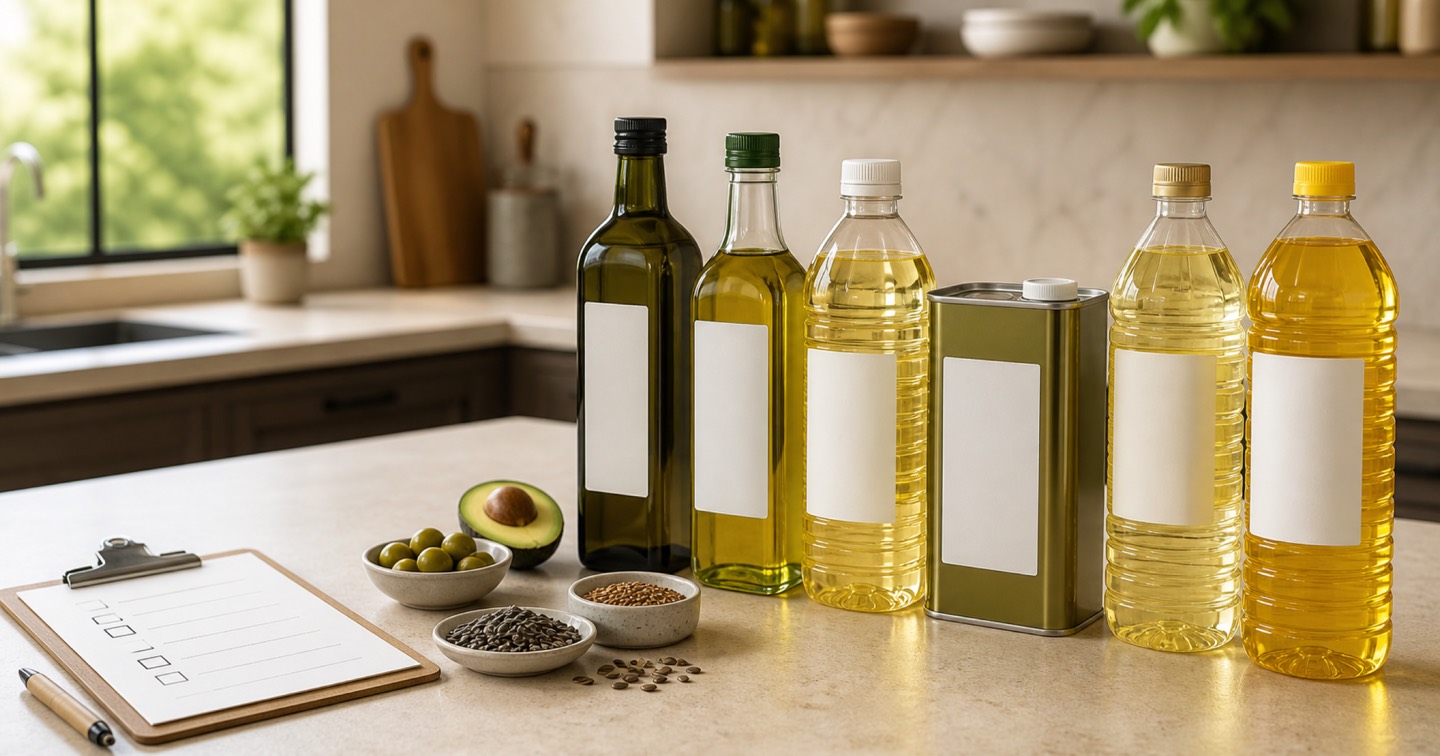
A store brand can be an excellent buy, but the retailer's name is not a chemical result, harvest date, or freshness guarantee. The most defensible online comparison asks a narrower question: what can a shopper verify about one exact bottle before buying it? Fridgeful reviewed current official product pages for seven retailer-owned oils and scored the public trail for identity, process, origin, verification, package fit, cooking guidance, and claim restraint.
This is not a health claim, not a safety finding, not a taste test, and not a laboratory analysis. It does not say one oil type is nutritionally better than another. Scores describe evidence quality, not the measured contents of a bottle. Local price and stock can change, and the physical label controls when it differs from a retailer page.
What “quality” can mean on an oil label
Start with identity. Federal ingredient rules require ingredients to use common or usual names under 21 CFR 101.4, but a one-line ingredient statement does not reveal crop origin, extraction temperature, storage, oxidation, or adulteration testing. “Canola oil” is useful identity evidence; it is not a complete quality system.
Category terms add different information. USDA's voluntary olive-oil grade standard defines extra virgin through both sensory requirements and chemical limits, including no more than 0.8 grams of free fatty acid per 100 grams. A product page that merely prints “extra virgin” does not show which lab or panel evaluated the lot. USDA Organic also has a real handling framework: 7 CFR 205.270 permits mechanical, biological, and physical methods while restricting certain substances. Organic certification still does not prove flavor, freshness, purity, or smoke point.
Avocado oil requires a higher evidence bar. UC Davis' avocado-oil research program says enforceable quality and purity standards are still needed. In its 2023 private-label study, summarized by UC Davis, 31% of 36 sampled oils were pure and 36% were of advertised quality. The brands were anonymized, so those results cannot convict or clear any ranked product. They make missing fatty-acid, sterol, supplier, and lot evidence meaningful.
Seven store-brand oils, ranked by public evidence
1. Good & Gather 100% Organic Spanish Extra Virgin Olive Oil, 16.9 fl oz — 89. Target's exact page gives the cleanest combined trail: cold extraction, 100% Spanish olives, USDA Organic, non-GMO, kosher, exact size, current price, and in-stock status. Target's owned-brand food program says every food item has a specification and its facilities face audit, testing, and open-date or lot-traceability requirements. Those retailer controls are useful, but shoppers still cannot see a mill, harvest, chemical panel, sensory result, or lot certificate.
2. 365 Extra Virgin Mediterranean Olive Oil, 101.4 fl oz — 78. Whole Foods' exact product page says the cold-processed blend is tested to International Olive Council standards and lists baking, sauteing, sauces, vinaigrettes, and marinades. That is the strongest category-specific testing statement in this set. It remains a statement rather than a visible lot result; the page does not name the countries, producer, harvest, lab, or test date. The 101.4-ounce package also needs genuinely fast household turnover.
3. Kirkland Signature Organic Extra Virgin Olive Oil, 2 L — 65. Costco's item 692731 identifies a two-liter plastic bottle, cold extraction, USDA Organic, and kosher status. Costco's responsible-sourcing framework asks suppliers whether they can map a supply chain to origin. The exact oil page does not publish that map, a country blend, harvest, producer, chemistry, or sensory result. The selected online warehouse was unavailable during review, so this is a current listing rather than a promise of local stock.
4. Good & Gather Canola Oil, 1 gal — 59. Target's one-gallon page gives neutral-use guidance, kosher status, and a 445 F smoke-point claim for frying, baking, and dressings. Target's broader specifications and lot-traceability program make the retailer context stronger than the product page alone. Still, the page does not name seed origin, extraction or refining steps, certifier, test method, or lot result. A gallon is good value only if the household can use it before prolonged open storage becomes the bigger problem.
5. 365 Avocado Oil, Expeller Pressed, 16.9 fl oz — 56. Whole Foods' official listing identifies expeller-pressed refined avocado oil, a practical 16.9-ounce format, high-heat use, neutral flavor, kosher, and non-GMO signals. Whole Foods also publishes general food ingredient standards. Neither page exposes avocado origin, processor, fatty-acid or sterol testing, supplier controls, or a lot certificate. After the UC Davis findings, an exact ingredient line alone is not authenticity proof.
6. Great Value Canola Oil, 48 fl oz — 51. Walmart's exact listing names canola oil as the ingredient and describes neutral flavor plus frying, stir-fry, dressing, and baking uses. The 48-ounce bottle is more realistic for many homes than a gallon. But the public page does not identify seed origin, extraction, refinement, producer, certification, testing, traceability, or a protective package feature. That supports an everyday-use conclusion, not a stronger quality conclusion.
7. Simply Nature Avocado Oil, 17 fl oz — 41. ALDI's current product page gives the exact size, store-specific price, and ingredient “refined avocado oil.” It also places the product inside Simply Nature's restricted-ingredient program. Fridgeful found no public fruit origin, extraction detail, authenticity test, supplier trail, lot certificate, or temperature guidance tied to this exact oil. The honest reading is identifiable but not publicly verified for avocado-oil purity.
Fridgeful Signal Ranking
This is an editorial ranking of public label, process, traceability, verification, package, use, and claim-discipline signals. It is not a health claim, safety claim, fraud finding, flavor judgment, or laboratory result.
| Rank | Exact store-brand product | Score | Criteria scores | Evidence-led read |
|---|---|---|---|---|
| 1 | Good & Gather Organic Spanish EVOO, 16.9 fl oz | 89 | 19/19/17/12/13/9 | Best combined single-country, process, certification, and exact-SKU trail. |
| 2 | 365 Mediterranean EVOO, 101.4 fl oz | 78 | 17/14/18/7/14/8 | Strong IOC-testing statement; broad origin and bulk size reduce confidence. |
| 3 | Kirkland Signature Organic EVOO, 2 L | 65 | 16/8/14/7/11/9 | Clear organic cold-extracted baseline; exact origin remains thin online. |
| 4 | Good & Gather Canola Oil, 1 gal | 59 | 14/4/11/7/15/8 | Strong cooking guidance and retailer controls; little crop or process detail. |
| 5 | 365 Expeller Pressed Avocado Oil, 16.9 fl oz | 56 | 16/4/5/11/13/7 | Useful process and use details without public authenticity testing. |
| 6 | Great Value Canola Oil, 48 fl oz | 51 | 14/3/3/9/14/8 | Clear identity and uses; limited verification and traceability. |
| 7 | Simply Nature Avocado Oil, 17 fl oz | 41 | 13/2/2/10/6/8 | Exact size and ingredient, but the thinnest category-specific evidence. |
Criteria scores follow the rubric order in the article data: exact product and process 20; origin and traceability 20; category verification 20; package and freshness fit 15; use-case clarity 15; claim discipline 10.
What to check on the physical bottle
Match the oil type, ingredient statement, size, UPC or item code, country of origin, certifier, best-by or harvest date, and lot code to the online claim. Prefer a size your household can finish, keep it closed away from heat and light, and write the opening date on the package. For extra virgin olive oil, a named harvest, producer, chemical standard, or sensory program improves the trail. For avocado oil, look for recurring fatty-acid and sterol testing, supplier traceability, or a lot-level certificate. A higher price is not proof, and a low price is not a verdict.
Finally, treat changes as new evidence. Private-label suppliers, countries, formulas, and packages can change while the front brand stays familiar. Recheck the current label instead of letting an old purchase stand in for the next bottle.
Sources
- Olive Oil and Olive-Pomace Oil Grades and Standards. USDA Agricultural Marketing Service. Accessed 2026-08-08.
- 21 CFR 101.4, Food; designation of ingredients. Electronic Code of Federal Regulations. Accessed 2026-08-08.
- 7 CFR 205.270, Organic handling requirements. Electronic Code of Federal Regulations. Accessed 2026-08-08.
- Avocado Oil. UC Food Quality / UC Davis. Accessed 2026-08-08.
- Nearly 70% of Private Label Avocado Oil Rancid or Mixed With Other Oils. UC Davis College of Agricultural and Environmental Sciences. Accessed 2026-08-08.
- 100% Organic Spanish Extra Virgin Olive Oil, 16.9 fl oz, Good & Gather. Target. Accessed 2026-08-08.
- Food Safety Quality & Regulatory Compliance. Target Corporation. Accessed 2026-08-08.
- Canola Oil, 1 gal, Good & Gather. Target. Accessed 2026-08-08.
- 365 Extra Virgin Mediterranean Olive Oil, 101.4 fl oz. Whole Foods Market. Accessed 2026-08-08.
- 365 Avocado Oil, Expeller Pressed, 16.9 fl oz. Whole Foods Market. Accessed 2026-08-08.
- Food Ingredient Quality Standards. Whole Foods Market. Accessed 2026-08-08.
- Kirkland Signature Organic Extra Virgin Olive Oil, 2 L. Costco. Accessed 2026-08-08.
- Sustainability Products and Responsible Sourcing. Costco. Accessed 2026-08-08.
- Great Value Canola Oil, 48 fl oz. Walmart. Accessed 2026-08-08.
- Simply Nature Avocado Oil, 17 fl oz. ALDI. Accessed 2026-08-08.